

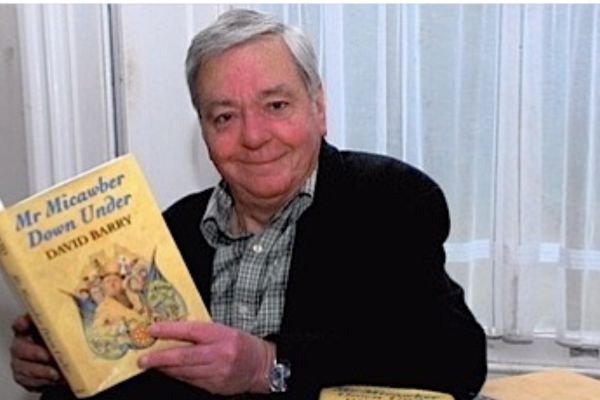
There are performers who burn brightly for a season, then quietly disappear. And then there are those who simply refuse to stop. David Barry falls squarely into the second group. Born in North Wales, trained on some of Britain’s most prestigious stages, and beloved by millions as one of television’s most memorable comic characters, he has spent over six decades proving that genuine talent does not have an expiry date. His story is one of reinvention, persistence, and a creative restlessness that continues to this day.
Early Life: A Welsh Boy With a Stage in His Blood
David Barry was born Meurig Wyn Jones on 30th April 1943 in Bangor, a market town on the north-western coast of Wales. He attended Hillgrove School in Bangor before crossing the Menai Straits to continue his education in Anglesey. From an early age, the pull of performance was obvious and undeniable. His family recognised it, and eventually so did the wider world.
David Barry path led him south to London, where he enrolled at The Corona Academy stage school in Chiswick. It was a decision that would shape everything. The Academy had already produced Dennis Waterman, Richard O’Sullivan, and Jeremy Bulloch names that would become fixtures in British entertainment. Barry was walking into serious company, and he rose to meet it.
A Child Actor Among Legends
By the age of twelve, Barry was already working at a professional level. What followed was remarkable by any standard.
He toured Europe in 1957 in a prestigious production of Titus Andronicus, performing alongside Sir Laurence Olivier and Vivien Leigh. As a teenager, he filmed with Hollywood star Tyrone Power and shared a stage with the great Paul Scofield. For most actors, one of those names would represent the pinnacle of a career. For David Barry, they were simply the early chapters.
His first stage role came at the Theatre Royal, Windsor, playing Harlen in Life With Father. It was a modest beginning — but it gave him a foundation that would support everything that came after.
The Name That Stuck
David Barry performed under a stage name rather than his birth name, Meurig Wyn Jones. The choice was pragmatic the entertainment industry of the 1960s favoured names that audiences could latch onto quickly. Whatever the reasoning, the name David Barry became the one that millions of British television viewers would come to recognise and love.
Please Sir! and the Character That Made Him Famous
When Please Sir! launched on London Weekend Television in 1968, British sitcoms were at something of a golden peak. The show followed a well-meaning but hopelessly inexperienced young teacher trying to manage a class of difficult teenagers at the fictional Fenn Street Comprehensive in South London. It was warm, fast, and genuinely funny.
David Barry played Frankie Abbott a gum-chewing, swaggering boy utterly convinced of his own toughness. The reality, of course, was quite different. Frankie was a coward, a mummy’s boy, and thoroughly out of his depth whenever confronted by anything resembling genuine danger.
That contrast between Frankie’s inflated self-image and his actual spinelessness was where Barry worked his magic. His timing was instinctive, his physicality perfectly calibrated, and his commitment to the character absolute. Starring alongside John Alderton, Deryck Guyler, and Joan Sanderson, as well as fellow pupils played by Peter Cleall, Peter Denyer, Malcolm McFee, and Liz Gebhardt, Barry helped build an ensemble that audiences genuinely adored.
Please Sir! ran until 1972. Its popularity was strong enough to produce a feature film in 1971, in which Barry reprised the role to considerable audience delight.
The Fenn Street Gang and the First Steps Into Writing
After Please Sir! ended, the story continued with a spin-off series, The Fenn Street Gang, which followed the class of 5C into adult life. Barry returned as Frankie Abbott throughout its run. The spin-off aired for two series before being cancelled in 1973, never quite reaching the heights of its predecessor.
However, it gave Barry something arguably more important than viewing figures. It gave him his first opportunity as a broadcast writer. He contributed scripts to The Fenn Street Gang, quietly discovering a second creative voice that would eventually carry him far beyond television comedy. In 1980, he also appeared in the feature film adaptation of the Thames Television favourite George and Mildred, further demonstrating his range and durability as a screen performer.
The Writer Takes Over
The shift from actor to writer was never a sudden leap for David Barry it was a gradual, deliberate evolution. After his early scriptwriting experience on The Fenn Street Gang, he went on to write episodes of the popular Thames Television sitcom Keep It in the Family during the 1980s.
Beyond television, he wrote scripts for public and private sector organisations, tackling serious workplace themes including bullying, disability, race, and sexual orientation through the medium of training theatre. It was purposeful, socially engaged work and it revealed a writer with something to say beyond punchlines.
In 2005, he created what is widely considered the first weekly internet soap opera in the United Kingdom, Careless Talk, set in Tunbridge Wells, where he has made his home. It was a bold creative gamble, and a clear signal that David Barry was never going to sit still.
Crime Fiction and the DI Lambert Novels
Barry’s move into prose fiction produced his most sustained body of literary work. His debut novel, Each Man Kills, a police comedy thriller rooted in the landscapes of Swansea, was published in 2002. It introduced Detective Inspector Lambert a character who would become the anchor of a growing crime series.
Further novels followed, including Willie the Actor, Muscle, A Deadly Diversion, and Walking Shadows. His Welsh settings give the books an atmospheric authenticity that grounds each plot in something genuine and specific. Additionally, his short story collection Tales from Soho and his children’s novel The Ice Cream Time Machine demonstrated a literary range that extends well beyond the crime genre.
His autobiography, Flashback: An Actor’s Life, published in 2006, gave readers a frank account of over four decades in entertainment. It covered those extraordinary early encounters with Olivier and Leigh, the golden years of British sitcoms, and the quieter but equally rewarding work that followed. His literary tastes — Dickens, Steinbeck, Rankin, Chandler, Val McDermid reveal a writer with serious ambitions and genuine respect for the craft of storytelling.
Frankie Abbott Lives On
One of the most telling aspects of David Barry’s career is his willingness to revisit and reframe his most famous character rather than simply leave him in the past. In 2016, he reprised Frankie Abbott in his own stage play, A Day in the Lives of Frankie Abbott, performed at the Edinburgh Fringe Festival and later at the Phoenix Arts Club in London. The production introduced Frankie to a new generation while offering long-standing fans something fresh and genuinely entertaining.
He also appeared in the horror comedy short films Frankula (2017) and Bad Friday (2018), both featuring an older Frankie Abbott in delightfully absurd situations. These projects showed a performer comfortable enough in his own legacy to play with it, subvert it, and find new humour within it. That kind of creative confidence is rare, and it speaks directly to Barry’s enduring vitality as a performer.
Why David Barry Deserves Far More Recognition
It is easy, in the rush of modern entertainment, to overlook figures whose greatest fame arrived in a different era. That would be a significant mistake in the case of David Barry. He performed alongside Laurence Olivier as a twelve-year-old boy. He created one of British television’s most beloved comic characters. He transitioned into prose fiction and built a credible, varied literary career. He continues to write, perform, and engage audiences well into his eighties.
That is not nostalgia. That is a body of work that deserves to be properly appreciated by those who grew up watching Frankie Abbott and by those who are only just discovering the full remarkable story of the man behind him.
