
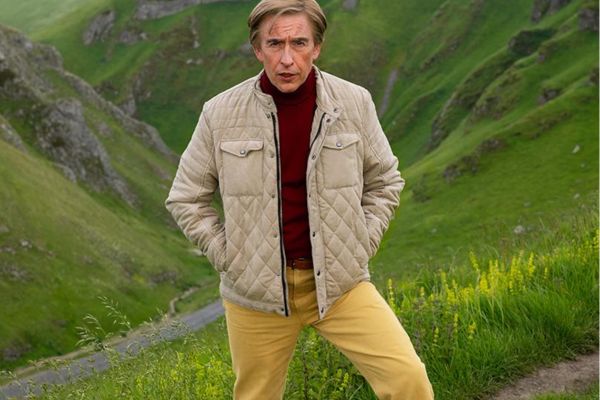
There are very few entertainers in British cultural life who have managed to be genuinely funny, genuinely dramatic, and genuinely controversial sometimes all at once. Steve Coogan is one of them. Over a career stretching more than four decades, he has moved from satirical puppet shows to Hollywood blockbusters, from beloved sitcom characters to critically lauded biographical dramas, without ever quite losing the restless creative energy that made him stand out in the first place. He is, in every sense, a difficult man to pin down — and that, arguably, is precisely what makes him so fascinating.
Growing Up in Manchester: The Making of a Mimic
Stephen John Coogan was born on 14 October 1965 in Middleton, Lancashire, into a large Irish Catholic family — one of six children. It was a working-class upbringing in a community where humour was currency, and Coogan showed early on that he had an instinct for it. He could mimic voices almost before he could hold a conversation properly, and that gift for impersonation would eventually become the cornerstone of his early professional life.
Steve Coogan went on to study drama at Manchester Polytechnic, where he sharpened his technical skills alongside his natural talent. Though he wasn’t working on the West End stage or dreaming of classical theatre in the way some of his contemporaries were, his ambitions were no less serious. He wanted to make people laugh — but on his own terms, with characters and ideas he had created himself. That instinct toward originality would define everything that followed.
Spitting Image and the Edinburgh Breakthrough
Coogan broke into the industry in the 1980s as a voice artist on Spitting Image, the legendary ITV satirical puppet show that lampooned politicians, celebrities, and public figures with gleeful irreverence. It was the perfect training ground. Working on the show forced him to study the rhythms and quirks of how real people spoke — a discipline that would serve him enormously well throughout his career.
In the early 1990s, Steve Coogan began developing original comic characters rather than simply imitating existing ones. That shift proved pivotal. He took those characters to the Edinburgh Festival Fringe, where he won the prestigious Perrier Award at the time, the comedy world’s most coveted accolade for new talent. Suddenly, people in the industry were paying very close attention. Furthermore, his collaboration with writer and broadcaster Armando Iannucci was beginning to bear fruit in ways nobody could quite have predicted.
Alan Partridge: Britain’s Most Uncomfortable Anti-Hero
The Birth of a Legend
If Steve Coogan has a single creation that defines his legacy, it is undoubtedly Alan Partridge. The character first appeared on the BBC radio programme On the Hour and the television news satire The Day Today in the early 1990s a pompous, self-important, socially oblivious regional media personality who somehow believed he was far more important than he actually was. The joke was always at Alan’s expense, but delivered with such precise observation and such evident affection for the character’s tragic dimensions that audiences couldn’t help but love him.
From Radio to Television Phenomenon
Partridge subsequently expanded into his own television series, most notably Knowing Me, Knowing You with Alan Partridge and the follow-up I’m Alan Partridge, which ran into the early 2000s. These shows earned Coogan multiple BAFTA nominations and wins for Best Comedy Performance. The writing was razor-sharp, the characterisation immaculate, and the cringe comedy long before “cringe comedy” became a recognised genre was executed with surgical precision.
What made Partridge genuinely special, though, was the pathos beneath the bluster. Alan was a failure who didn’t know he was failing. Steve Coogan was lonely, deluded, and yet oddly endearing. Coogan understood that complexity completely, and he played it without ever winking at the audience or asking for sympathy. The result was one of the most enduring comic creations in British television history.
The Feature Film and the Return
In 2013, Alan Partridge: Alpha Papa brought the character to the big screen, opening at number one at the British box office. The film was a genuine crowd-pleaser, and it proved that Partridge could sustain a cinematic narrative without losing any of his essential awkwardness. Coogan returned to the role again in 2019 with This Time with Alan Partridge on BBC One, which received rave reviews and introduced the character to an entirely new generation of viewers. The love for Alan Partridge, it seems, is essentially indestructible.
Making the Leap: Coogan as a Serious Dramatic Actor
Philomena and the Oscar Nomination
For a long time, there was a tendency unfair but understandable to think of Steve Coogan primarily as a comedian. Philomena changed that perception for good. Released in 2013, the film told the true story of Philomena Lee, an Irish woman who spent decades searching for the son taken from her by the Catholic Church as a young mother. Coogan not only starred in the film as journalist Martin Sixsmith but also produced and co-wrote the screenplay alongside Jeff Pope.
The film earned Coogan two Academy Award nominations for Best Picture and Best Adapted Screenplay — and was praised by critics worldwide for its warmth, intelligence, and emotional restraint. It was a remarkable achievement, and it confirmed that his ambitions as a filmmaker and storyteller extended well beyond the comedy that had first made him famous.
Stan & Ollie: Inhabiting a Legend
In 2018, Coogan took on another demanding biographical role, playing Stan Laurel in Stan & Ollie alongside John C. Reilly as Oliver Hardy. The film focused on the legendary comedy duo’s twilight years — a later period in their careers when fame had faded and their friendship was strained. Critics responded warmly, and Coogan received a BAFTA nomination for Best Actor in a Leading Role. His portrayal of Laurel was notably understated, built on gesture and expression rather than obvious technique, and it revealed yet again how far his range truly extended.
The Reckoning: Taking on the Unplayable
Perhaps the boldest role of Coogan’s career to date came in 2023 with The Reckoning, the BBC One drama depicting the life and crimes of Jimmy Savile. Many people in the industry considered the role essentially unplayable the cultural revulsion surrounding Savile was so intense that any actor taking it on risked both professional criticism and public backlash. Coogan accepted the challenge regardless. The result drew widespread critical praise, with reviewers describing his performance as brave, chilling, and deeply unsettling a portrait that illuminated how predators hide in plain sight without ever sensationalising the subject matter.
Recent Work: Still Restless, Still Evolving
Brian and Maggie
In January 2025, Coogan starred in Brian and Maggie, a Channel 4 dramatisation directed by Stephen Frears in which he played the broadcaster Brian Walden opposite Harriet Walter’s Margaret Thatcher. The two-part drama examined a pivotal television interview between the two figures and received considerable attention for both its performances and its sharp political writing.
The Penguin Lessons
Also in 2025, The Penguin Lessons arrived in UK cinemas a warmhearted comedy-drama in which Coogan played a British teacher in 1970s Argentina who rescues an oil-soaked penguin. Directed by Peter Cattaneo, the film showcased a gentler, more reflective side of Coogan’s screen presence, and it was received fondly by audiences looking for something altogether less abrasive than his recent dramatic work.
Beyond Acting: Producer, Writer, and Activist
It would be a mistake to think of Steve Coogan solely as a performer. In 1999, he co-founded Baby Cow Productions with writer Henry Normal, a company that has since produced some of British television’s most distinctive and original comedy programming. His involvement behind the camera writing, producing, shaping projects from the ground up reflects a creative ambition that goes well beyond simply turning up on set.
He is also a vocal political voice, a committed supporter of the Labour Party who has campaigned actively for electoral reform and media accountability. His testimony during the Leveson Inquiry into press standards in 2012 drew particular attention, as he spoke candidly about the impact of tabloid intrusion on his private life. That willingness to engage publicly with difficult issues adds another dimension to a public persona that is, in any case, far more complex than his comic creations might initially suggest.
A Career Unlike Any Other
Steve Coogan has won seven BAFTA Awards, three British Comedy Awards, the Perrier Award, and received two Oscar nominations a body of recognition that reflects the extraordinary breadth of what he has achieved. More than the trophies, though, what defines his career is the consistent refusal to stay still. He could have spent the last twenty years touring as Alan Partridge and lived very comfortably. Instead, he has kept pushing into drama, into producing, into difficult and controversial territory because that is simply who he is.
In a British entertainment landscape that often rewards safety and familiarity, Steve Coogan has consistently chosen the harder road. And the work, invariably, has been better for it.

1 Comment
I’ve always appreciated Steve Coogan’s dry humor. What’s your favorite performance of his from that four-decade span?