

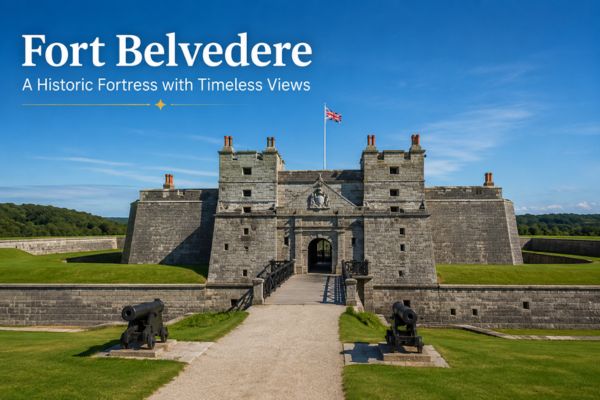
Tucked away in the quiet woodland of Windsor Great Park, Fort Belvedere doesn’t look like a place that altered the course of British history. It’s small, slightly eccentric, and easy to miss if you don’t know where to look. Yet this unassuming country house became the stage for one of the most dramatic royal episodes of the twentieth century. Understanding Fort Belvedere means understanding how a Georgian folly slowly transformed into a home fit for a king, and eventually, the backdrop to his downfall.
A Folly Built for Fun, Not Function
Fort Belvedere began life in 1750 as little more than a whimsical structure on Shrubs Hill, commissioned by the Duke of Cumberland. Back then, it had a simple triangular shape with turrets, designed purely as a decorative summer boathouse rather than a serious residence. Wealthy landowners of that era loved building follies like this, structures meant to impress visitors rather than serve any practical purpose.
For decades, Fort Belvedere remained exactly that: an architectural curiosity rather than a proper home. However, things changed significantly when Jeffry Wyatville took on the task of remodelling the building in the 1820s. He reshaped it in the Gothic Revival style, giving it the castellated, fairy-tale appearance that still defines it today. As a result, the fort gained a sense of grandeur it had previously lacked.
From Curiosity to Country House
Although Wyatville’s renovations gave Fort Belvedere more architectural weight, it still wasn’t considered a serious family residence for many years afterwards. Various members of the royal family used it occasionally, but none truly made it their own. It sat somewhat dormant, admired more for its charm than its comfort, until the late 1920s brought an unexpected turning point.
Edward, Prince of Wales, Falls in Love With the Fort
In 1929, Edward, Prince of Wales, took on the lease of Fort Belvedere, and everything changed almost overnight. Unlike his predecessors, Edward genuinely adored the place. He poured time, money, and personal attention into renovating both the house and its sprawling grounds, turning it from a neglected oddity into a comfortable retreat he could call home.
Gardening became something of an obsession for Edward during this period. He famously cleared rhododendrons by hand, built new terraces, and added a swimming pool, which was a rare luxury at the time. Consequently, Fort Belvedere stopped feeling like a museum piece and started feeling lived-in, warm, and personal. Friends who visited often remarked on how relaxed and informal life there felt compared to the stiff formality of other royal residences.
A Private Escape From Royal Duty
What made Fort Belvedere special wasn’t grandeur, ironically, but intimacy. Edward used it as an escape from the rigid formality of court life, hosting small gatherings rather than lavish state occasions. This informality suited his personality, and it’s precisely why the house became so central to his life. The fort offered him privacy at a time when his personal choices were beginning to attract intense public scrutiny.
The Abdication Crisis Unfolds
Fort Belvedere’s most significant moment in history arrived in December 1936, during one of the most turbulent periods the British monarchy has faced. Edward, by then King Edward VIII, wished to marry Wallis Simpson, an American divorcee. This caused a constitutional crisis, since the British government and the Church of England strongly opposed the match, particularly given Simpson’s marital history.
As pressure mounted from politicians, the press, and the public alike, Edward retreated to Fort Belvedere to weigh his options. It was here, away from the formality of Buckingham Palace, that he made his final decision. Ultimately, he chose love over the crown, signing the Instrument of Abdication at the fort on 10 December 1936. This single act ended his reign after less than a year on the throne.
Why the Location Mattered
It’s worth pausing on why Fort Belvedere, rather than a grander royal residence, hosted such a momentous decision. The fort represented everything Edward valued: privacy, comfort, and freedom from rigid tradition. Therefore, it made perfect sense that he would choose this particular setting to step away from the very institution that defined his public life.
Life After the Abdication
Following Edward’s departure, Fort Belvedere’s prominence faded considerably, although it didn’t disappear from royal use entirely. Various family members and tenants occupied the property over subsequent decades, including Gerald Lascelles and his wife Angela, who hosted notable guests there, including jazz musician Dizzy Gillespie. Even so, none of these later residents brought quite the same historical weight that Edward’s tenure had given the house.
For a long stretch, Fort Belvedere existed somewhat quietly, known mainly to royal historians and curious visitors rather than the general public. Nonetheless, its story never fully faded, partly because the abdication remains such a compelling chapter in British royal history, and partly because the building itself retained its unusual charm.
A Quiet Return to Relevance
Interest in Fort Belvedere has occasionally resurfaced, particularly whenever discussions arise about future royal residences or historic property restorations. Renovation work carried out by skilled designers has reportedly restored much of its former elegance, transforming what was once dismissed as an odd folly into something genuinely admired again. This renewed appreciation reflects how perceptions of historic buildings can shift dramatically over time.
What Fort Belvedere Represents Today
Today, Fort Belvedere remains part of the Crown Estate, though it operates under private leasehold arrangements rather than serving as an active royal residence. Visitors generally can’t access the property casually, since it sits within Windsor Great Park’s more restricted areas. Despite this, its story continues to attract attention from historians, royal enthusiasts, and anyone fascinated by the personal side of monarchy.
What makes Fort Belvedere genuinely compelling isn’t just its architecture or its royal connections, but rather what it symbolises. It represents a moment when personal desire collided head-on with institutional duty, and personal desire won. Few buildings in Britain carry that particular kind of historical weight, wrapped in such a modest, almost playful exterior.
Final Thoughts
Fort Belvedere’s journey, from a decorative Georgian folly to the site of a constitutional crisis, illustrates how ordinary buildings sometimes become extraordinary simply through the people who inhabit them. Edward VIII’s attachment to the fort wasn’t about status or grandeur; it was about finding a space where he could simply be himself. That, ultimately, is why this small house in Windsor Great Park still captures imaginations nearly a century later, long after the king who loved it gave up his throne for love.
