

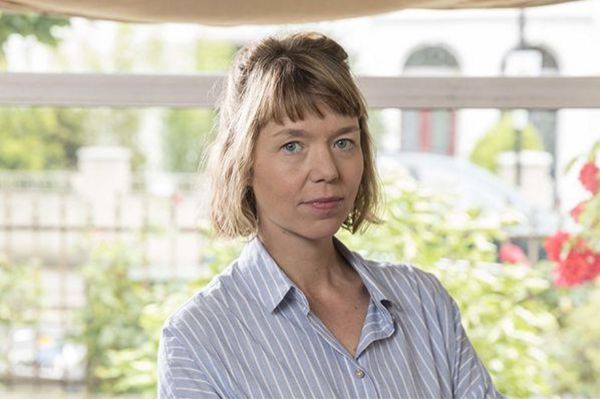
Some actors chase fame. Others simply keep doing brilliant work until fame finds them anyway. Anna Maxwell Martin belongs firmly in the second category. For two decades now, she’s built a career on precision, restraint, and an uncanny ability to make even the most difficult characters feel entirely human, whether she’s playing a Dickensian heroine, a corrupt police officer, or a grieving mother trying to hold her family together.
If you’ve watched British television at any point in the last twenty years, you’ve almost certainly seen her work, even if you didn’t clock the name straight away. This piece looks at who Anna Maxwell Martin is, how she got here, and why her career keeps getting more interesting rather than settling into comfortable repetition.
Early Life and an Unlikely Route Into Acting
Anna Maxwell Martin was born Anna Charlotte Martin on 10 May 1977 in Beverley, a market town in the East Riding of Yorkshire. Her father, Ivan, hailed from County Londonderry in Northern Ireland and worked as the managing director of a pharmaceutical company, while her mother Rosalind, a Scottish research scientist, gave up her career to raise Anna and her older brother, Adam.
Interestingly, acting wasn’t an obvious path for Martin growing up, since her family had no background in the arts whatsoever. She attended Beverley High School, where she took part in school plays, though her academic route afterwards went in a completely different direction. She studied history at Liverpool University, only turning seriously to acting once her degree was finished.
That decision led her to the London Academy of Music and Dramatic Art, or LAMDA, one of Britain’s most respected drama schools. She graduated in 2001, and it was around this time that she added “Maxwell,” her maternal grandfather’s first name, to her surname. The change was practical rather than stylistic: another Anna Martin was already registered with Equity, and she needed a way to stand apart.
Building a Reputation on Stage
Before television audiences knew her face, Martin was already turning heads in theatre. She landed an Olivier-nominated role playing Lyra, the twelve-year-old heroine of Philip Pullman’s His Dark Materials, a performance that announced her as a serious talent early in her career. She also appeared in Trevor Nunn’s production of Coast of Utopia and in Dumb Show at the Royal Court, working alongside respected names in British theatre.
That stage training shows up constantly in her screen work, even now. There’s a precision to her performances, a sense that every gesture and pause has been considered, which is exactly the kind of discipline theatre tends to instil. It’s part of why directors keep returning to her for roles that demand emotional accuracy rather than surface-level drama.
Bleak House and Her First BAFTA
Martin’s breakthrough came in 2005, when she played Esther Summerson in the BBC’s acclaimed adaptation of Charles Dickens’s Bleak House. The role earned her a British Academy Television Award, her first, and firmly established her as one of British television’s most promising talents. It’s the kind of period drama casting that can define a career, and in Martin’s case, it absolutely did.
Three years later, she won a second BAFTA for her performance as N in Channel 4’s Poppy Shakespeare, a role that showcased an entirely different register of acting altogether. Where Esther Summerson required warmth and moral steadiness, Poppy Shakespeare demanded something rawer and more unsettling. Winning BAFTAs for two such contrasting performances said a great deal about her range.
From Line of Duty to Motherland
As her career progressed, Martin kept proving she could move fluidly between genres without ever losing credibility in any of them. She played the icy, morally compromised DCS Patricia Carmichael in BBC One’s Line of Duty from 2019 to 2021, a role that made her one of the most talked-about villains on British television during that period. Fans of the show still debate her character’s motivations to this day.
Yet in the very same stretch of years, she was also making audiences laugh in Motherland, the BBC comedy that ran from 2016 to 2022. Her performance earned her a BAFTA nomination for Best Female Comedy Performance, proving she was just as sharp with comic timing as she was with menace and gravity. Few actors manage that particular balancing act convincingly, but Martin made it look effortless.
True Crime and Emotionally Demanding Roles
In more recent years, Martin has gravitated towards material that carries real emotional weight. She took the co-lead role in ITV’s Hollington Drive in 2021, playing one of two sisters grappling with a potential crime involving their children, alongside Rachael Stirling. The series relied heavily on subtlety and tension, exactly the territory where Martin thrives.
Then came her portrayal of Delia Balmer in the ITV true-crime miniseries, which eventually aired in 2024 under the title Until I Kill You. The performance drew widespread critical praise, including a five-star review from The Guardian’s Lucy Mangan, who singled out Martin’s work specifically. It’s the sort of role that reminds audiences why she keeps getting cast in stories that others might shy away from.
Recent and Current Projects
Martin’s momentum hasn’t slowed down. She’s appeared in Ludwig, taken roles in A Good Girl’s Guide to Murder, and starred in the BBC’s harrowing drama Unforgivable, which examines the devastating impact of grooming and sexual abuse on one family. These aren’t easy watches, and they aren’t easy roles to play, but Martin continues choosing projects that matter rather than ones that simply pay well.
A Life Marked by Resilience
Away from the screen, Martin’s personal life has involved genuine hardship, which she’s discussed with candour rather than concealment. She was married to acclaimed director Roger Michell, known for Notting Hill and The Duke, from 2010 until 2020, and the pair had two daughters, Maggie and Nancy. Even after their separation, they remained close, and Michell’s sudden death in 2021 left Martin grieving a friend as much as a former husband.
Rather than retreating from public life, Martin has spoken openly about grief, financial uncertainty, and rebuilding afterwards. That honesty seems to feed directly into her acting, lending her performances an authenticity that’s difficult to fake. She’s since found happiness with camera operator Rich Cornelius, whom she met on the set of Code 404.
Why Anna Maxwell Martin Still Matters
What sets Anna Maxwell Martin apart isn’t just her BAFTA wins or her impressive list of credits, though both are considerable. It’s her consistent refusal to play it safe, choosing roles that challenge her and, by extension, challenge her audience too. From Dickensian drama to true crime to sharp-edged comedy, she’s never settled into a single lane.
Given her track record, it seems unlikely she’ll start playing it safe now. Anna Maxwell Martin has spent two decades proving that skill outlasts spectacle, and everything about her recent work suggests she’s nowhere near finished surprising us.
