

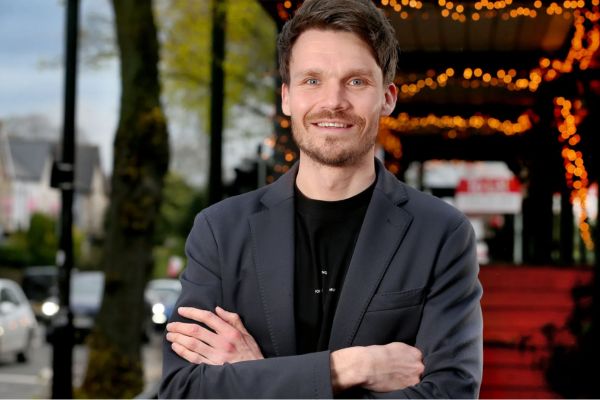
There are coaches who drift into management through comfort and convention, and then there are coaches like Danny Röhl — men who seem to have been built, deliberately and meticulously, for the highest level of the game. At 36 years old, Röhl is already one of the most compelling managerial stories in European football. His journey from an injury-cut playing career in the German lower leagues to the dugout of a club like Rangers is not just inspiring — it is genuinely fascinating, and it deserves to be told properly.
A Playing Career Cut Tragically Short
Danny Röhl was born on 28 April 1989 in Zwickau, a city in what was then East Germany. He grew up with football in his bones, eventually making his way through the youth system and into the senior ranks as a defender. He played for FSV Zwickau, FC Sachsen Leipzig II, and FC Eilenburg clubs operating in the lower tiers of German football, far from the spotlight of the Bundesliga. It was honest, unglamorous football, and Röhl gave it everything he had.
Then, aged just 21, an ACL injury ended his playing days entirely. For many young men in that situation, football becomes a painful memory. For Röhl, however, it became a doorway. Unable to continue on the pitch, he turned his sharp, analytical mind towards the touchline instead. Looking back now, it seems almost inevitable because the qualities that make a great coach were always there, simply waiting for the right outlet.
Learning Under the Masters
What followed was a coaching education that most managers would envy. Röhl began his career at RB Leipzig, one of Germany’s most forward-thinking clubs, where he worked alongside Ralph Hasenhüttl — a manager renowned for his high-energy pressing systems and meticulous tactical preparation. When Hasenhüttl moved to Southampton in 2018, Röhl followed him to the Premier League, gaining invaluable experience in English football and absorbing the unique pressures that come with working in the world’s most scrutinised league.
But the most significant chapter of his coaching education came in August 2019, when Röhl returned to Germany to join Hansi Flick’s backroom staff at Bayern Munich. This was not just any club. This was the Bayern Munich that proceeded to sweep up every trophy in sight. In his very first season at the Allianz Arena, Röhl was part of the coaching team that delivered the Bundesliga, the DFB Pokal, and the UEFA Champions League — an unprecedented treble achieved with breathtaking football. The following season, Bayern added the UEFA Super Cup, the DFL Supercup, and the FIFA Club World Cup. By any measure, Röhl had been exposed to elite football at its absolute peak.
From Club to Country
When Flick left Bayern to take charge of the German national team ahead of the 2022 FIFA World Cup, Röhl went with him. Working at international level adds another dimension to a coach’s understanding — the compressed preparation windows, the management of elite egos, the weight of an entire nation’s expectations. Röhl absorbed all of it. By the time he was ready to step out on his own, he carried with him the knowledge of some of the best coaching minds in world football. That is an extraordinary foundation.
The Sheffield Wednesday Miracle
In October 2023, Danny Röhl became a manager in his own right for the first time, appointed as head coach of Sheffield Wednesday in the Championship. At just 34, he became the youngest manager in the EFL — and he walked into one of the toughest situations imaginable. Wednesday were rooted to the bottom of the table, seven points adrift of safety with just three draws from their opening eleven matches. The mood around Hillsborough was desperate.
What happened next was nothing short of remarkable. Röhl immediately set about changing the culture, the structure, and the belief within the squad. He rotated between tactical shapes including 4-2-3-1, 4-4-2, 3-2-4-1, and 5-4-1 depending on the opposition and the circumstances, demonstrating from the very start that he was not a coach wedded to one rigid system. His use of a double pivot in midfield, his intelligent deployment of pressing triggers, and his ability to develop hybrid players who could adapt within fluid structures all marked him out as someone thinking several moves ahead.
The results spoke for themselves. Röhl transformed Wednesday’s points-per-game average from an abysmal 0.27 to an impressive 1.42. Sheffield Wednesday survived. It was one of the great Championship escapes in recent memory, and it announced Danny Röhl to the wider football world in emphatic fashion.
A Second Season and a Dignified Exit
The following campaign, Röhl guided Wednesday to a comfortable mid-table finish no small achievement given the severe financial constraints the club was operating under. Despite the limitations, he continued to develop players and implement his philosophy with quiet determination. When he departed by mutual consent in the summer of 2025, it was without bitterness or drama. His reputation had only grown, and the football world was watching closely to see where he would land next.
Ibrox Calls — Rangers Appoint Their Man
The opportunity came in October 2025. Rangers, one of the most storied clubs in world football, were in need of a new head coach after parting ways with Russell Martin. The Ibrox job carries enormous weight this is a club with 55 league titles, a passionate global fanbase, and the relentless pressure of the Old Firm rivalry hanging over every decision. It is not a posting for the faint-hearted.
Röhl was appointed on 20 October 2025, signing a two-and-a-half-year contract. He hit the ground running immediately, with his first match coming against SK Brann in the UEFA Europa League just days after his arrival. His words at the unveiling were measured and confident: he acknowledged the difficulty of the situation, embraced the scale of the expectations, and made clear that he intended to earn the trust of the supporters through performance on the pitch not promises in press conferences.
Rebuilding with a Clear Identity
At Rangers, Röhl has continued to implement his philosophy of tactical flexibility, collective pressing, and intelligent ball progression. His approach, as it was at Sheffield Wednesday, is not built around one fixed formation or one superstar. Instead, he builds systems where every player understands their role within a broader structure, where the team presses as a unit, transitions quickly, and builds from the back with purpose. His emphasis on hybrid players — those capable of fulfilling multiple roles depending on the game state has begun to reshape how Rangers play.
The 2025-26 season has been a journey of consolidation and momentum-building, with Rangers finishing third in the Scottish Premiership. Heading into the final stretch of the campaign, Röhl spoke openly about belief and confidence, describing the remaining fixtures as “finals” and rallying his squad to finish the season strongly. That kind of clear, direct communication is a hallmark of his management style.
What Makes Danny Röhl Different
In an era where many coaches rely on authority and reputation, Danny Röhl leads through analysis, education, and collective intelligence. He represents a modern generation of managers shaped by data and detail rather than tradition and hierarchy. His long-term vision centres on building clubs with a clear identity teams that know exactly how they want to play, regardless of the personnel available on a given day.
Furthermore, his career path is almost unique in its breadth. He has worked in the German lower leagues, at a revolutionary Red Bull club, in the Premier League, at the world’s most decorated domestic side, with a national team at a World Cup, and in the English Championship under severe financial pressure. Each environment taught him something different, and he has synthesised all of it into a coaching philosophy that is still evolving.
The Road Ahead
Danny Röhl is still only 36. He holds a UEFA Pro Licence and is under contract at Ibrox until June 2028. The expectation at Rangers is always for titles and trophies, and Röhl understands that better than most. Whether he ultimately delivers silverware at Ibrox or moves on to even larger stages in the years ahead, one thing is already clear: this is a coach of genuine substance.
The story of Danny Röhl is ultimately a story about what happens when adversity meets ambition, when a short playing career becomes the beginning of something far greater. He did not make it as a player. Instead, he made himself into something more lasting a coach who has already left his mark at every club he has touched, and who looks very much like he is only just getting started.
