
Every sentence you’ve ever read or spoken follows a hidden blueprint, whether you’ve noticed it or not. That blueprint is what linguists call syntax, and the word syntactical describes anything tied to those underlying rules. It sounds technical at first, yet once you understand it, you start noticing it everywhere, from a child’s first sentences to the most polished pieces of professional writing.
What Does “Syntactical” Actually Mean?
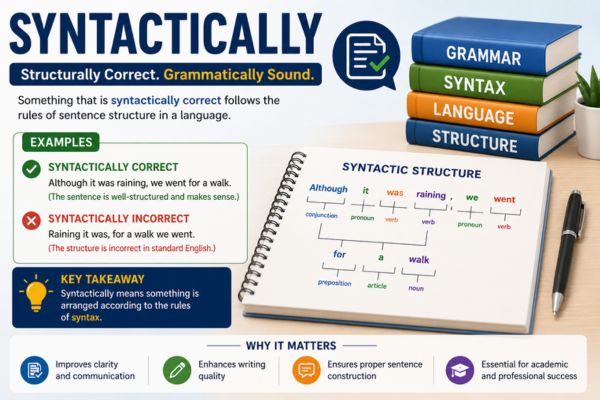
In simple terms, syntactical relates to the rules governing how words are arranged within a sentence to produce meaning. It’s an adjective, and it essentially describes anything that follows, breaks, or relates to the structural patterns of grammar. So when someone says a sentence has a syntactical error, they’re pointing to a problem with word order or structure, not necessarily with vocabulary or spelling.
It’s worth distinguishing it from semantic, since the two often get confused. Semantics deals with meaning, while syntax deals with structure. A sentence can be syntactically perfect yet semantically nonsensical, and linguists love using examples like “colourless green ideas sleep furiously” to prove exactly that point. The grammar holds up, but the meaning collapses entirely.
Where the Word Comes From
Like many academic-sounding English words, it has Greek and Latin roots. It traces back to the Latin term syntacticus, which itself borrowed from the Greek syntaktikos, meaning “joining together in order.” According to etymological records, the word entered English usage in the late 1500s, with documented evidence appearing as early as 1577 in the writing of H. Peacham.
That’s well over four centuries of continuous use, which says something about how essential the concept remains. Long before modern linguistics existed as a formal discipline, scholars were already wrestling with how word order shapes meaning. The word survived because the underlying idea, sentence structure governing comprehension, never stopped being relevant to anyone who writes, speaks, or studies language.
Why Syntactical Structure Matters So Much
You might wonder why something as seemingly mechanical as word order deserves this much attention. The truth is, syntactical structure quietly controls how clearly your ideas land with a reader or listener. Two sentences can contain identical words yet produce completely different impressions purely because of how those words are ordered.
Consider this example: “We sometimes take a train to Paris” versus “We take a train to Paris sometimes.” Both sentences are syntactically valid, yet they emphasise different things. The first stresses frequency, while the second draws attention to the destination. That subtle shift, governed entirely by syntax, demonstrates why writers who understand it rules tend to communicate with far more precision.
Common Syntactical Elements in English
Several core elements make up syntactical structure, and recognising them helps writers spot weaknesses in their own work. Word order sits at the top of the list, followed closely by subject-verb agreement, clause arrangement, and the correct placement of modifiers like adjectives and adverbs. Each of these elements interacts with the others to create sentences that feel natural rather than clumsy.
Punctuation, although sometimes overlooked, also plays a syntactical role. Commas, semicolons, and full stops don’t just separate ideas; they signal structural relationships between clauses. A misplaced comma can shift meaning just as dramatically as a misplaced word, which is exactly why editors pay such close attention to these small but powerful it markers.
Syntactical Errors and Why They Happen
Most syntactical errors creep in when writers rush, translate directly from another language, or simply lose track of a long sentence’s structure. Multilingual writers, in particular, often carry syntactical habits from their first language into English, which can create sentences that feel slightly “off” even when every individual word is correct. This isn’t a flaw; it’s simply a natural consequence of how deeply syntax is wired into our thinking.
Native English speakers aren’t immune either. Long, complex sentences with multiple clauses are especially prone to syntactical breakdown, since it becomes easy to lose track of subject-verb agreement or dangling modifiers partway through. That’s why experienced editors often recommend reading sentences aloud; awkward it patterns tend to reveal themselves the moment they’re spoken rather than silently read.
How to Strengthen Your Syntactical Awareness
Improving your grasp of syntax doesn’t require a linguistics degree, fortunately. Reading widely exposes you to countless sentence patterns, which trains your ear to recognise what sounds structurally sound. Likewise, deliberately varying your sentence length and structure while writing forces you to engage actively with syntax rather than relying on autopilot phrasing.
Another effective method involves studying how skilled writers manipulate syntactical structure for effect. Short, punchy sentences create urgency, while longer, layered sentences build complexity and nuance. Once you start noticing these choices, you’ll find yourself making more deliberate decisions in your own writing, rather than simply defaulting to whatever sentence structure comes first to mind.
Syntactical Structure in Different Contexts
Syntax doesn’t behave identically across every type of writing. Academic writing typically favours dense, layered syntactical structures, with multiple subordinate clauses packed into a single sentence. Journalism, by contrast, tends to favour shorter, clearer syntactical patterns designed for quick comprehension under time pressure.
Creative writing arguably enjoys the most syntactical freedom of all. Poets and novelists frequently break conventional rules entirely, fragmenting sentences or reordering clauses to create rhythm, tension, or emotional impact. These deliberate deviations only work, however, because the writer understands the standard syntactical rules well enough to break them with purpose rather than confusion.
Why This Concept Still Matters in 2026
As artificial intelligence tools increasingly generate written content, understanding syntactical structure has become more valuable, not less. Recognising awkward or unnatural syntax helps writers and editors spot machine-generated text that, while grammatically passable, often lacks the natural rhythm and variation found in human writing. Syntax, in other words, has quietly become a marker of authenticity.
Moreover, anyone working in education, publishing, or content creation benefits enormously from a sharper syntactical eye. Spotting structural weaknesses early prevents miscommunication and strengthens overall clarity, which ultimately matters more than vocabulary choice in most professional writing contexts.
Final Thoughts
Syntax might sound like a dry, technical concept reserved for grammar textbooks, but it shapes nearly everything we read and write. Understanding what makes a sentence syntactically sound, rather than merely grammatically correct, gives writers a genuine edge. It’s the difference between sentences that simply exist on a page and sentences that actually communicate with precision and rhythm.
Ultimately, paying attention to syntactical structure transforms writing from a series of correct words into something far more deliberate and effective. Whether you’re a student, a professional, or simply someone who loves language, sharpening this awareness pays off in nearly every piece of writing you’ll ever produce.
