
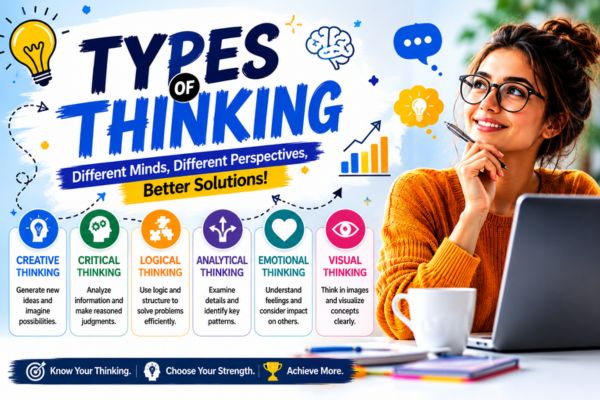
Have you ever wondered why two people can look at the exact same problem and arrive at completely different solutions? The answer often comes down to the types of thinking each person leans on. Thinking isn’t a single, uniform process. Instead, it’s a collection of distinct mental approaches, each suited to different situations, and learning to recognise them can genuinely change how you work, study and make decisions.
Most of us drift through life using whatever thinking style feels natural, without ever questioning whether it’s the right tool for the job. However, once you understand the different types of thinking available to you, you start choosing the right mental approach for the right moment. That shift alone can improve everything from your career performance to your everyday problem-solving.
In this article, we’ll walk through the most useful types of thinking, explain what each one looks like in practice, and show you exactly when to reach for it.
Why Understanding Types of Thinking Actually Matters
Thinking shapes nearly every decision you make, yet it rarely gets the attention it deserves. Schools teach facts and formulas, but they rarely teach students how to think strategically about thinking itself. As a result, many people default to one or two familiar styles, even when a situation calls for something entirely different.
Employers, meanwhile, consistently rank thinking skills among the most desirable qualities in candidates. Critical thinking, in particular, regularly tops hiring surveys because it signals someone who can evaluate information objectively rather than reacting on instinct. So, building awareness of the different types of thinking isn’t just an academic exercise; it’s a genuinely practical skill that pays dividends in real working life.
Convergent and Divergent Thinking: Two Sides of the Same Coin
Among all the types of thinking, convergent and divergent thinking are probably the most widely discussed, and for good reason. Convergent thinking narrows things down. It takes multiple possibilities and filters them until one clear, correct answer remains. This is the thinking you use when solving a maths equation or answering a multiple-choice question, where precision and logic matter more than imagination.
Divergent thinking works in the opposite direction. Rather than narrowing options, it expands them, generating as many ideas as possible without worrying about which one is “right.” Brainstorming sessions thrive on divergent thinking, as do creative writing tasks and product design challenges. Interestingly, the strongest thinkers don’t pick one over the other; they switch between convergent and divergent modes depending on what the task demands.
When to Use Each Style
If you’re troubleshooting a technical fault or following a strict procedure, convergent thinking will usually serve you better, since it rewards structure and accuracy. On the other hand, if you’re trying to come up with fresh marketing angles or new product features, divergent thinking opens the door to possibilities you wouldn’t otherwise consider. Knowing which mode suits the moment is half the battle.
Critical Thinking: The Skill Employers Can’t Stop Talking About
Critical thinking deserves its own spotlight because it underpins almost every other type of thinking on this list, acting as the glue that holds the other types of thinking together. At its core, critical thinking means evaluating information objectively, questioning assumptions, and reaching conclusions based on evidence rather than emotion or bias. It’s the mental discipline that stops you from accepting the first answer that sounds plausible.
People who think critically tend to ask better questions. They probe for evidence, consider alternative explanations, and remain comfortable with uncertainty until the facts justify a conclusion. Consequently, critical thinking shows up everywhere, from boardroom strategy meetings to everyday decisions like choosing which news source to trust. Developing this skill takes practice, but the payoff is a sharper, more reliable decision-making process.
Analytical Versus Creative Thinking
Analytical thinking and creative thinking often get framed as opposites, though they actually complement each other rather nicely, and together they represent two of the most practical types of thinking for everyday work. Analytical thinking breaks a complex problem into smaller, manageable parts, examining each piece methodically before drawing a conclusion. It’s the structured, step-by-step approach you’d use when reviewing financial data or debugging a piece of code.
Creative thinking, meanwhile, thrives on imagination and the freedom to explore unconventional ideas. It doesn’t follow a fixed sequence, and it often produces its best results when the mind is allowed to wander a little. Writers, designers, and entrepreneurs rely heavily on this style, yet even creative work benefits from a dose of analytical thinking once the initial ideas need refining into something workable.
Blending the Two for Better Results
The most effective problem-solvers don’t choose between analytical and creative thinking; they blend them. Generate ideas freely first, then switch into analytical mode to test, refine and prioritise those ideas. This back-and-forth approach tends to produce stronger outcomes than relying on either style alone, particularly in fields like product development or strategic planning.
Concrete and Abstract Thinking: Two More Essential Types of Thinking
Concrete thinking deals with facts as they are: literal, direct, and grounded in observable reality. If someone asks you what time a meeting starts, concrete thinking gives you the straightforward answer without overanalysing it. This style proves especially useful in situations demanding precision, such as following instructions or interpreting data exactly as presented.
Abstract thinking, by contrast, looks beyond the surface to find patterns, relationships and deeper meaning. It allows you to connect seemingly unrelated ideas and apply lessons from one context to a completely different situation. Philosophy, strategic planning and theoretical research all depend heavily on abstract thinking, since they require seeing the bigger picture rather than isolated facts.
Reflective and Metacognitive Thinking
Reflective thinking involves looking back at past experiences to extract useful lessons, and it’s one of the quieter types of thinking that rarely gets the credit it deserves. Rather than rushing toward the next task, reflective thinkers pause to consider what worked, what didn’t, and why. This habit builds self-awareness over time and helps prevent the repetition of avoidable mistakes, both at work and in personal life.
Metacognitive thinking takes this a step further by examining the thinking process itself. It’s essentially thinking about how you think, questioning whether your current approach is actually effective. Students who practise metacognition tend to perform better academically, largely because they catch flawed reasoning before it leads them astray. Together, reflection and metacognition form a powerful feedback loop for continuous improvement.
Lateral and Associative Thinking: The Less Obvious Types of Thinking
Lateral thinking approaches problems from unexpected angles, deliberately challenging assumptions that everyone else takes for granted. It’s the style behind those clever solutions that seem obvious only after someone else points them out. Businesses facing stagnant markets often turn to lateral thinking when conventional strategies have stopped producing results.
Associative thinking, meanwhile, lets the mind wander freely between seemingly unrelated concepts. It’s loosely connected to daydreaming, yet it often produces surprisingly useful insights, since unexpected connections sometimes reveal solutions that structured thinking would never uncover. Many breakthrough ideas in science and art trace back to a moment of associative thinking rather than rigid logical analysis.
Bringing It All Together
No single type of thinking works best in every situation, and that’s really the whole point. Recognising the strengths and limitations of each style gives you the flexibility to switch approaches depending on what a task actually demands. A good decision-maker doesn’t rely on instinct alone; they consciously choose the mental tool that fits the problem in front of them.
Ultimately, becoming a stronger thinker isn’t about mastering one impressive skill. It’s about building a flexible mental toolkit and knowing when to reach for convergent precision, divergent imagination, critical scrutiny, or reflective insight. Once you start paying attention to how you think, you’ll naturally make sharper decisions, solve problems more efficiently, and approach challenges with far greater confidence.
