

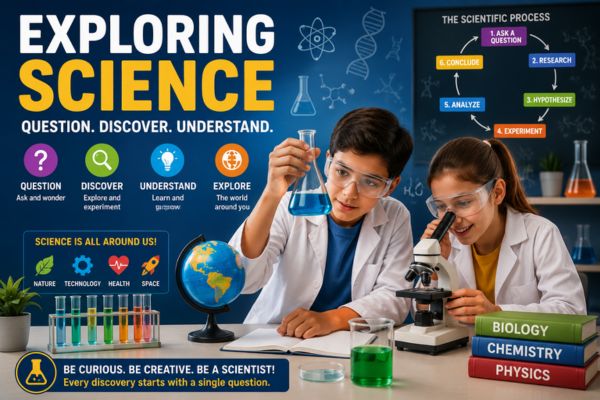
Science has always been less about having answers and more about asking the right questions. Exploring science, in its truest sense, is a process of poking around, observing closely, and following curiosity wherever it leads. Whether you’re a student in a classroom or simply someone fascinated by how the world works, that spirit of exploration is what keeps the entire field moving forward.
What Exploring Science Really Means
At its core, exploring science isn’t about memorising facts from a textbook. Instead, it’s about engaging with the world through observation, questioning, and experimentation. Many people assume science is a fixed set of established truths, but in reality, it’s an ongoing process shaped by trial, error, and the occasional happy accident. That misconception often puts people off, when in fact the messiness is part of the appeal.
Interestingly, some of history’s biggest scientific breakthroughs came from moments of pure serendipity. Henri Becquerel, for example, stumbled upon radioactivity in 1896 after noticing that photographic plates stored near uranium salts had become mysteriously exposed, despite being kept in a dark drawer. He could have dismissed it as a ruined experiment. Instead, his background knowledge in physics helped him recognise the significance of what he was seeing, turning a lucky accident into a landmark discovery.
The Role of Curiosity and Background Knowledge
It’s tempting to think discovery is purely about luck, but that’s rarely the full picture. Scientists generally need a solid foundation of background knowledge before they can make sense of an unusual observation. Without that grounding, an unexpected result might just look like a mistake. With it, the same observation can spark an entirely new line of inquiry, which is exactly why education plays such a critical role in scientific progress.
This is also why exploring science works best when it’s treated as a habit rather than a one-off activity. Asking questions, sharing ideas with others, and reviewing what’s already known all feed into the process. Scientists rarely work in isolation; they build on the accumulated knowledge of their community, refining and challenging previous ideas as new evidence comes to light. That collaborative element often gets overlooked in popular depictions of science.
How Schools and Programmes Encourage Scientific Exploration
Educational institutions have long recognised that exploring science needs to be hands-on to be effective. Several textbook series, particularly those aligned with the Next Generation Science Standards, focus heavily on earth, life, and physical sciences through engaging investigations rather than passive reading. These resources often introduce real-world scientists and explorers, helping students see science as something living people actually do, rather than an abstract subject confined to pages.
Some programmes go even further by adapting content for different learning needs. There are curricula specifically designed for students who read below grade level, using simplified language and visual symbols to make complex scientific concepts more accessible. This inclusive approach matters because curiosity about the natural world isn’t limited to strong readers; everyone deserves a way into exploring science that suits how they learn best.
Seminars, Career Programmes, and Real-World Exposure
Beyond the classroom, several organisations run structured opportunities for young people to explore scientific careers directly. Programmes aimed at students from around 6th grade through their late teens often expose participants to fields like astronomy, forensic science, microbiology, and environmental science. These hands-on experiences let students test whether a particular path genuinely interests them, rather than guessing based on textbook descriptions alone.
University-led seminar series add another layer to this picture. Some institutions host monthly sessions where leading experts introduce school students to current research happening right now in various scientific fields. These talks aren’t designed to turn every attendee into a scientist, but they do broaden exposure to ideas that students might never encounter in a standard curriculum. Sometimes, that one seminar is enough to spark a lifelong interest.
The Psychology Behind Scientific Discovery
There’s also a fascinating cognitive side to exploring science that’s worth mentioning. Researchers have studied how children and adults actually think when they’re trying to make a discovery, looking at the difference between approaching problems as a “theorist” versus as an “experimenter.” Both approaches are valid, and most scientists tend to lean more naturally toward one style, even if they use elements of both depending on the situation.
Understanding these cognitive patterns has practical value beyond academic curiosity. It helps explain why some people are quicker to spot patterns in data, while others excel at designing the perfect experiment to test a theory. Recognising your own natural inclination can actually make exploring science more enjoyable, since you can lean into strengths rather than forcing yourself into an unfamiliar way of thinking.
Why Mistakes Matter More Than People Realise
One thing that often gets lost in how science is taught is how essential mistakes are to the process. Scientific reasoning involves being fallible, and recognising patterns of error is just as important as recognising patterns of success. Rather than viewing a failed experiment as wasted effort, experienced scientists treat it as valuable information that narrows down what’s actually happening. This mindset shift alone can transform how someone approaches exploring science, whether in a lab or at home.
Bringing Exploration Into Everyday Life
You don’t need a laboratory or a university degree to start exploring science in a meaningful way. Simple observations, like watching how plants grow differently depending on sunlight, or noticing patterns in weather, can spark genuine scientific thinking. The key is asking why something happens and then trying to figure out an answer, even if that answer takes time, research, or a bit of trial and error to uncover.
Museums, science centres, and even online digital libraries have made it easier than ever for families to engage with hands-on STEM activities from home. Many of these resources require nothing more than household materials, proving that exploring science doesn’t have to be expensive or complicated to be genuinely engaging. It just requires a willingness to be curious and occasionally get things wrong along the way.
Final Thoughts on Exploring Science
Ultimately, exploring science is less about reaching a final destination and more about embracing an ongoing process of discovery. From classroom textbooks to university seminars, from accidental discoveries to structured career programmes, there are countless ways to engage with this process at any age. What matters most is maintaining that sense of curiosity, because that’s genuinely what pushes scientific understanding forward, one question at a time.
Whether you’re a student trying to decide on a future career, a parent looking for engaging activities, or simply someone who’s always wondered how things work, exploring science offers something valuable. It rewards patience, encourages questioning, and consistently proves that the most interesting answers often come from the most unexpected places. That, in many ways, is the whole point of science itself.
