
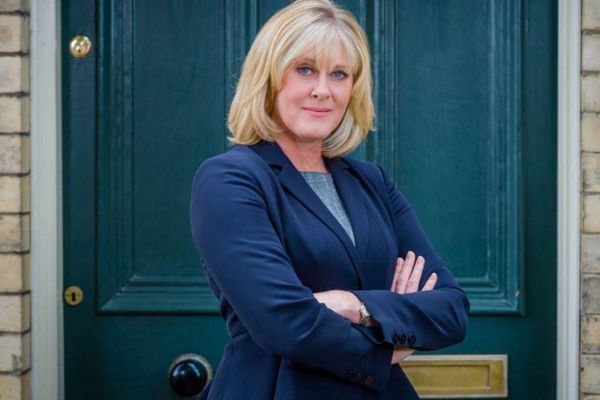
There’s a particular kind of actress who doesn’t chase the spotlight, yet somehow ends up holding the entire screen whenever she appears. Sarah Lancashire is exactly that performer. From cobbled soap opera streets to the bleak, windswept moors of Yorkshire crime drama, she’s spent four decades proving that subtlety, when done properly, hits far harder than spectacle ever could.
What makes Sarah Lancashire so compelling isn’t simply her range, although that’s considerable. It’s the way she inhabits characters who feel lived-in and painfully real, whether she’s playing a soap stalwart or a battle-worn police sergeant. Audiences trust her instantly, and that trust has been earned through decades of consistently excellent, unshowy work that rewards close attention rather than demanding it.
From Oldham to the Guildhall: Where It All Began
Born in Oldham, Lancashire, in October 1964, Sarah Lancashire grew up in a household already steeped in television storytelling. Her father, Geoffrey Lancashire, worked as a scriptwriter on Coronation Street, which meant the rhythms of British soap drama were practically woven into her childhood. Even so, her own path into acting wasn’t handed to her on a plate, and she had to work determinedly to carve out a career of her own.
After attending Oldham Hulme Grammar School, she went on to study at the prestigious Guildhall School of Music and Drama, graduating in 1986. By her own admission, those years were intense and occasionally intimidating, yet they laid the foundation for everything that followed. Rejections from several repertory theatre companies tested her resolve early on, but persistence eventually paid off when she landed her first professional role with the Manchester Library Theatre Company.
Early Struggles That Shaped Her Resilience
It’s worth pausing here, because Sarah Lancashire’s early career wasn’t a smooth, glamorous ascent. She has spoken candidly about experiencing clinical depression from the age of seventeen, a struggle that, at times, made even basic professional obligations feel overwhelming. Travelling to auditions in London occasionally became an enormous psychological hurdle, something she’s described with remarkable honesty in later interviews.
That openness matters, particularly in an industry that often glosses over the harder realities behind public success. Rather than letting those struggles define or limit her, Lancashire pushed through them, gradually building a body of work that would eventually mark her out as one of British television’s most respected performers. Her resilience, in many ways, became just as defining as her talent.
The Coronation Street Years and Rising Fame
Sarah Lancashire’s breakthrough arrived in 1991, when she took on the role of Raquel Wolstenholme, later Watts, in Coronation Street. The character became enormously popular with viewers, and Lancashire remained with the soap until 1996, departing partly due to an exhausting filming schedule and a growing desire to explore other projects beyond the cobbles. Her final scenes reportedly drew an audience of around twenty million viewers, a staggering figure by any measure.
Following her departure, she didn’t simply fade from view, though. Instead, she signed a lucrative two-year contract with ITV in 2000, which, at the time, made her the highest-paid television actress in the country. This period also saw her appear in Where the Heart Is and Clocking Off, further demonstrating that she was far more versatile than her soap opera fame might have initially suggested.
Building a Reputation for Dramatic Depth
As her career progressed through the 2000s, Sarah Lancashire began taking on increasingly layered, emotionally demanding roles. Her performance in adaptations and miniseries during this period revealed a willingness to inhabit difficult, sometimes uncomfortable territory, rather than settling into easily likeable parts. This shift quietly repositioned her as a serious dramatic actress, distinct from her earlier soap stardom.
Critics took notice too, even when opinions occasionally diverged. Some reviewers praised her subtlety and quiet strength, while others argued she was simply continuing to prove an already well-established talent. Either way, the consensus increasingly settled on one point: Sarah Lancashire had matured into an actress capable of carrying genuinely weighty material on her shoulders alone.
Happy Valley and a New Level of Recognition
If there’s one role that cemented Sarah Lancashire’s status among Britain’s finest television actresses, it’s undoubtedly Sergeant Catherine Cawood in Happy Valley. The character, hardened by personal tragedy yet fiercely committed to her job and family, demanded an extraordinary balance of vulnerability and steel. Lancashire delivered both in equal measure, earning widespread critical acclaim and a string of major award wins.
Alongside Happy Valley, her performance in Last Tango in Halifax further showcased her ability to bring warmth and complexity to ordinary, relatable characters navigating extraordinary emotional terrain. Both roles earned her Best Actress recognition at the British Academy Television Awards, while Happy Valley also brought her a National Television Award for Best Drama Performance, cementing her reputation across multiple corners of the industry.
A Career Built on Range, Not Repetition
What’s particularly impressive about Sarah Lancashire’s filmography is how rarely she repeats herself. Her credits span everything from Doctor Who and Oliver Twist to The Paradise, Upstairs Downstairs, and more recent projects like Black Doves and Julia. Few actresses manage such breadth without losing a sense of identity, yet Lancashire consistently brings something distinctive to each role, regardless of genre or tone.
This versatility hasn’t gone unnoticed by industry institutions either. Beyond her acting awards, she was appointed an Officer of the Order of the British Empire in 2017 for services to drama, before receiving an even higher honour, Commander of the Order of the British Empire, in the 2025 New Year Honours. Such recognition reflects not just individual performances, but a sustained, decades-long contribution to British television as a whole.
Life Beyond the Screen
Away from acting, Sarah Lancashire’s personal life has been similarly marked by resilience and quiet strength. She was previously married to Gary Hargreaves, with whom she had two sons, before later marrying television executive Peter Salmon in 2001. Together, the couple share six sons between their respective families, building a busy, blended household alongside Lancashire’s demanding filming schedules.
Her willingness to discuss mental health struggles openly has also added another dimension to her public profile. Rather than presenting a polished, untroubled image, she’s chosen honesty about depression and personal hardship, which has arguably made her connection with audiences feel even more genuine. That authenticity, both on screen and off, continues to define how she’s perceived across British culture.
Final Thoughts
Sarah Lancashire’s career resists easy summary, largely because it refuses to stay within one lane. From soap opera stardom to award-winning dramatic performances, she’s continually reshaped expectations of what British television acting can achieve. Decades after her first nervous steps onto a Manchester stage, she remains one of the most respected, consistently compelling performers working in the industry today, and there’s little sign of that changing anytime soon.
