

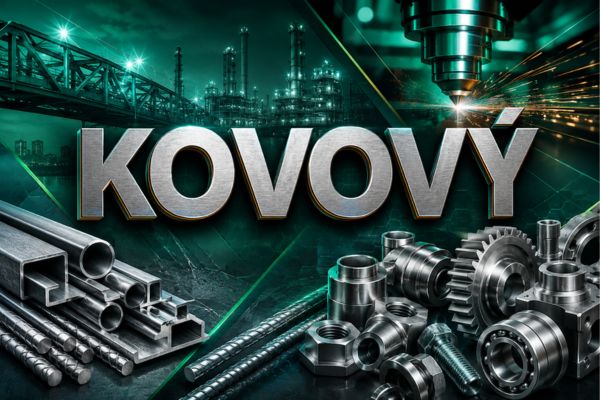
Metal is everywhere. It holds up the building you work in, frames the car you drive, and runs through the device you’re reading this on. Yet despite its overwhelming presence in daily life, few people stop to think about the rich linguistic and industrial heritage packed into a single Czech word — kovový — which simply means “metallic” or “made of metal.” It’s a word that carries centuries of human ingenuity within it, and understanding it opens a fascinating window into how civilisations have always relied on metal to push boundaries and build the future.
What Does Kovový Actually Mean?
At its core, kovový is a Czech adjective derived from the root word kov, meaning “metal.” The word translates directly into English as “metallic” — referring to anything composed of, resembling, or relating to metal. In Czech grammar, the adjective flexes depending on the gender and number of the noun it describes, appearing as kovová in the feminine form, kovové in the neuter, and kovových in the genitive plural — a form commonly found in technical and engineering documentation.
In everyday Czech usage, the word appears in phrases such as kovový rám (metal frame), kovové součástky (metallic components), or povrch kovových dílů (the surface of metallic parts). Its versatility makes it indispensable in fields ranging from architecture and automotive engineering to consumer electronics and aerospace design. Far from being a dusty linguistic curiosity, kovový remains one of the most practically relevant adjectives in any technical language.
A Brief History of Metalworking
The Origins of Metal Culture
Humanity’s relationship with metallic materials stretches back thousands of years. The Copper Age gave way to the Bronze Age, which in turn ushered in the Iron Age each transition representing a leap forward in what people could build, fight with, and create. Kovový materials, in other words, have always been at the heart of human progress.
Central Europe, including the Czech lands, has a particularly rich tradition of metalworking. During the medieval period, Bohemian miners and smiths were among the most skilled in Europe, producing everything from agricultural tools to armour and weapons. The knowledge passed down through those generations formed the foundation of the modern Czech manufacturing industry one that continues to thrive today. This history is not merely sentimental; it shaped real industrial infrastructure, trade networks, and engineering standards that still influence how kovový materials are produced and applied.
The Industrial Revolution and the Rise of Modern Metallurgy
The Industrial Revolution turbocharged humanity’s use of metal. Steam engines, railways, and mechanised factories all depended on reliable kovový components gears, pistons, rails, and boilers that could withstand enormous stress and heat. This era essentially transformed metalworking from a craft into an engineering science. New alloys were developed, quality standards emerged, and the demand for metallic materials exploded across every sector of the economy.
By the 20th century, the development of stainless steel, aluminium alloys, titanium, and high-performance superalloys opened entirely new chapters. Today, the study and application of kovový materials sits at the intersection of physics, chemistry, and engineering a discipline that continues to evolve rapidly.
Types of Kovový Materials and Their Properties
Ferrous Metals
Ferrous metals contain iron as their primary element and form the backbone of heavy industry. Steel — an alloy of iron and carbon is arguably the most important kovový material in the world. It builds bridges, reinforces concrete, and forms the structural skeletons of skyscrapers. Cast iron, wrought iron, and various steel grades each offer distinct properties in terms of hardness, ductility, and tensile strength, making them suitable for very different applications.
What makes ferrous kovový materials so valuable is their combination of strength and affordability. They are relatively easy to produce at scale, and modern steel manufacturing has become remarkably efficient. The primary drawback, of course, is susceptibility to corrosion which is why engineers often treat ferrous metals with coatings, galvanisation, or alloying elements like chromium to create corrosion-resistant variants such as stainless steel.
Non-Ferrous Metals
Non-ferrous kovový materials do not contain significant amounts of iron. Aluminium, copper, titanium, and zinc all fall into this category, and they offer properties that ferrous metals simply cannot match. Aluminium, for example, is lightweight yet strong a combination that makes it ideal for aircraft fuselages, vehicle bodies, and packaging. Copper, meanwhile, is an exceptional electrical conductor, which is why it runs through virtually every piece of electronic equipment on the planet.
Titanium deserves a special mention. Though it is expensive to process, its extraordinary strength-to-weight ratio and resistance to corrosion make it the kovový material of choice in aerospace engineering, medical implants, and high-performance sports equipment. When you need a metal that can survive both a human body and the edge of the atmosphere, titanium is often the answer.
Alloys: The Best of Multiple Worlds
Alloys are engineered kovový materials that combine two or more metallic elements and sometimes non-metals to achieve specific properties. Bronze (copper and tin), brass (copper and zinc), and stainless steel (iron, carbon, and chromium) are among the most well-known examples. Modern metallurgy has produced hundreds of specialised alloys tailored for extreme conditions: high temperatures, intense pressure, corrosive environments, or the need for ultra-precision tolerances.
The science of alloy design is one of the most active areas of materials research today. Engineers are constantly searching for combinations that offer better performance at lower weight, or longer service life in challenging conditions. Consequently, kovový alloys underpin innovation across virtually every major industry.
Industrial Applications of Kovový Materials
Construction and Civil Engineering
The built environment depends on kovový materials in ways that most people take for granted. Steel reinforcement bars give concrete tensile strength it lacks naturally. Structural steel frames allow buildings to rise dozens of storeys into the sky. Aluminium cladding, copper roofing, and titanium façades give modern architecture its distinctive visual character, while also providing durability that lasts for generations.
Infrastructure projects bridges, tunnels, dams, and railways similarly rely on kovový materials for strength, longevity, and resistance to environmental forces. Without them, modern civil engineering would simply not be possible at the scales we now consider routine.
Automotive and Aerospace Industries
Both the automotive and aerospace sectors are defined, in large part, by their relationship with kovový materials. Car manufacturers use high-strength steel and aluminium alloys to build vehicles that are simultaneously safe, fuel-efficient, and durable. The trend towards electric vehicles has also driven demand for copper a critical kovový material in motors, batteries, and charging infrastructure.
In aerospace, the performance requirements are even more demanding. Aircraft components must withstand enormous mechanical stress, extreme temperature fluctuations, and years of continuous cycling without failure. Titanium alloys, nickel superalloys, and advanced aluminium composites fill these roles, enabling aircraft to fly safely and efficiently across millions of kilometres of flight time.
Electronics and Technology
Every smartphone, laptop, and data centre relies on kovový materials at the component level. Copper carries electrical signals. Gold ensures reliable connections in high-frequency circuits. Rare earth metals such as neodymium go into the powerful magnets inside electric motors and loudspeakers. Without these carefully chosen kovový elements, modern digital technology simply would not function.
Sustainability and the Future of Kovový Materials
Recycling and the Circular Economy
One of the most compelling arguments for continued investment in kovový materials is their recyclability. Unlike many other industrial materials, metals can be recycled repeatedly without significant loss of their fundamental properties. Steel, aluminium, and copper are among the most recycled materials on the planet, and the energy savings from recycling versus primary production are substantial — up to 95% in the case of aluminium.
As societies move towards more sustainable industrial models, the recyclability of kovový materials becomes an increasingly important advantage. Circular economy principles — which emphasise keeping materials in use for as long as possible align naturally with the physical properties of metals.
Advanced Kovový Materials on the Horizon
Research into new kovový materials and manufacturing techniques continues to accelerate. Metallic glasses, high-entropy alloys, and metal-matrix composites are among the most exciting frontiers. Additive manufacturing commonly known as 3D printing is also transforming how kovový components are designed and produced, enabling geometries that were previously impossible to achieve with traditional machining.
Looking ahead, the demand for specialised kovový materials will only grow, driven by renewable energy infrastructure, electric mobility, and ever-more-sophisticated electronics. The word kovový may have ancient roots, but the story of metallic materials is very much still being written.
Conclusion
From the first bronze tools of ancient civilisation to the titanium alloys powering today’s aircraft, kovový materials have shaped human history and continue to define our built world. Understanding what kovový means — both linguistically and industrially — offers a deeper appreciation for the invisible metallic framework that holds modern life together. Whether you work in engineering, architecture, manufacturing, or simply live in a world constructed from metal, kovový is a concept worth knowing. After all, the materials that built yesterday’s world are still very much building tomorrow’s.
