

The Shift Nobody Saw Coming — Until It Was Everywhere
Not long ago, a product was simply a thing you could hold in your hands. It had a label, a barcode, maybe a warranty card tucked inside the box. That was it. Today, that same product might carry embedded sensors, communicate with warehouse systems in real time, and deliver personalised content to a consumer’s phone the moment they scan its packaging. That transformation has a name: product digitalization and it is reshaping industries far more profoundly than most people realise.
This is not just a technology story. It is a story about how businesses think about what a product actually is. Because in a digitally connected world, a product is no longer just an object. It is a source of data, a channel of communication, and a living asset that continues to create value long after it leaves the factory floor.
What Product Digitalization Actually Means
There is often confusion between terms like digitisation, digital transformation, and product digitalization. They are related, but they are not the same thing. Digitisation, in the simplest sense, is converting analogue information into a digital format scanning a paper document, for instance. Digital transformation is broader; it refers to the sweeping organisational changes that come from adopting digital technologies across operations.
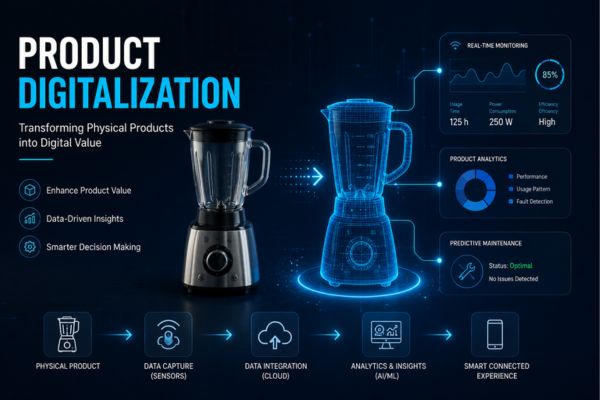
Product digitalization sits somewhere in the middle, and it is far more specific. It is the process of embedding digital capabilities directly into physical products through sensors, software, connectivity, QR codes, RFID tags, or digital twins so that those products can generate, transmit, and receive data throughout their entire lifecycle. It is, essentially, giving products a digital voice.
The Difference Between a Smart Product and a Dumb One
Think of it this way. A tin of olive oil sitting on a supermarket shelf is a passive object. A digitally enhanced tin of olive oil, on the other hand, can tell you exactly which grove the olives came from, when they were harvested, how many times the product was handled in transit, and whether it has been stored at the correct temperature. That is not science fiction — that is product digitalization in action, and it is already happening across the food, pharmaceutical, and fashion industries.
Why Businesses Are Taking This Seriously Right Now
The timing of this shift is not accidental. Several forces have converged to make product digitalization not just possible, but genuinely necessary. Consumer expectations have changed dramatically. People increasingly want to know what they are buying, where it came from, and whether the brand behind it can be trusted. Regulatory pressure around supply chain transparency is also intensifying, particularly in the European Union. And the competitive landscape means that businesses clinging to purely physical products are losing ground to those that have embraced the digital layer.
Furthermore, the technology has become dramatically more affordable. IoT sensors, cloud infrastructure, and data analytics tools that once required enterprise-level budgets are now accessible to mid-sized businesses. The barrier to entry has dropped. As a result, product digitalization has moved from a nice-to-have innovation experiment to a genuine business imperative.
The Supply Chain Gets Smarter
One of the most immediate and measurable benefits of product digitalization shows up in the supply chain. When products carry digital identities whether through RFID tags, serialised QR codes, or embedded sensors every movement through the supply chain becomes visible and trackable. That level of transparency has enormous practical implications.
Counterfeit goods, for instance, are a multi-trillion-pound global problem. Digitally authenticated products are significantly harder to fake. Returns fraud, which costs retailers billions every year, becomes far easier to detect and prevent when each product carries a unique digital record. Cold chain compliance critical in food and pharmaceuticals can be monitored and verified automatically rather than relying on manual checks.
Beyond risk management, the operational efficiency gains are substantial. Real-time inventory data reduces overstocking and stockouts. Logistics become predictive rather than reactive. Suppliers and retailers can collaborate more effectively when they are all drawing from the same live digital data rather than outdated spreadsheets and paper records.
How Brands Are Using Product Digitalization to Connect With Consumers
Supply chain transparency is just one dimension of product digitalization. The consumer-facing applications are equally compelling and increasingly, they are where the most exciting innovation is happening.
When a consumer scans a QR code on a product, they are not just accessing product information. They are entering a digital experience that the brand controls entirely. That might mean loyalty points, augmented reality features, personalised recipes, or sustainability credentials. Crucially, it also means the brand collects first-party data about that consumer who they are, where they are, when they engage, and how they use the product. In a world where third-party cookies are disappearing, that kind of direct consumer insight is extraordinarily valuable.
Building Consumer Trust Through Transparency
Trust has become a genuine competitive advantage, particularly among younger consumers. Product digitalization gives brands the tools to demonstrate their values not just claim them. A clothing brand can use it to show the exact journey a garment took from raw material to retail floor. A food company can verify its organic or fair trade claims with auditable digital records rather than vague marketing language. That kind of radical transparency does not just build consumer confidence; it also holds the brand itself accountable in ways that sharpen internal standards.
The Real Challenges Behind the Opportunity
It would be dishonest to present product digitalization as a frictionless path to business transformation. The challenges are real, and organisations that underestimate them tend to struggle. Technology is rarely the hardest part. What tends to trip businesses up is the human and organisational dimension.
Legacy systems that were never designed to handle digital product data can be stubborn and expensive to integrate. Internal cultures often resist the change in workflows that product digitalization requires. Skill gaps are common businesses need people who understand both the physical product world and the data and technology layer that sits on top of it. Data security and privacy considerations add another layer of complexity, particularly when consumer-facing digital touchpoints are involved.
Turning Digital Investment Into Commercial Value
Perhaps the most underappreciated challenge is commercial alignment. Many businesses invest heavily in product digitalization infrastructure but struggle to translate that investment into a clear value proposition that consumers or retail partners are willing to pay for. The technology is only as valuable as the business model it supports. Companies that succeed in product digitalization tend to start with the customer and work backwards asking what problem this solves for the person buying the product, not just what data it generates internally.
Getting Started: A Practical Way to Think About It
Product digitalization does not have to begin with a sweeping overhaul. In practice, the most successful implementations start small, prove value quickly, and scale from there. A single product line, a pilot with a key retail partner, or a focused use case around anti-counterfeiting or loyalty engagement these are all legitimate entry points.
What matters most at the start is clarity of purpose. Why are you digitalising this product? What specific outcome are you trying to achieve? That clarity shapes every subsequent decision, from technology selection to data strategy to consumer experience design. Without it, businesses end up with digital capabilities that nobody uses.
The Bigger Picture
Product digitalization is not a trend that will plateau and stabilise. As connectivity becomes more ubiquitous, as consumers grow more comfortable with digital product interactions, and as regulation increasingly mandates supply chain transparency, the digital layer on physical products will become the norm rather than the exception. The businesses building those capabilities now are not just chasing efficiency gains they are positioning themselves for a commercial landscape in which the product itself is a platform.
The shift from shelves to signals is already well underway. The question is not whether product digitalization will reshape your industry. It is simply whether your business will lead that change or scramble to catch up with it.
