
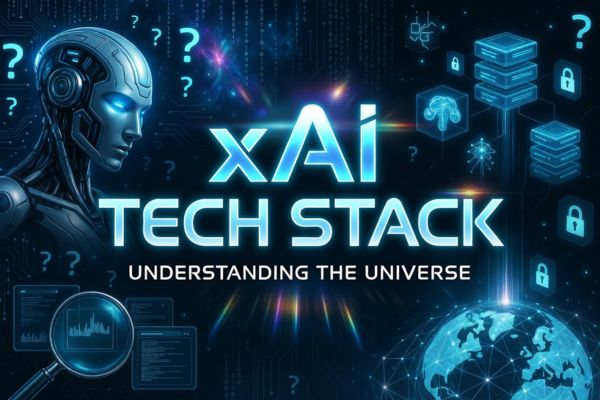
Artificial intelligence has become one of the most competitive sectors in modern technology, and few companies have attracted as much attention as xAI. Founded by Elon Musk, xAI aims to accelerate human scientific discovery and build AI systems capable of understanding the universe more effectively. As interest in the company continues to grow, many developers, investors, and technology enthusiasts are eager to understand the xAI tech stack that powers its products and research.
The technology behind advanced AI models is often as fascinating as the models themselves. From large-scale computing infrastructure to machine learning frameworks and data pipelines, every component plays a crucial role in creating intelligent systems. The xAI tech stack represents a modern approach to AI development, combining cutting-edge software with one of the world’s most ambitious computing environments.
In this article, we will explore the key components of the xAI tech stack, examine the technologies believed to support Grok, and understand why this infrastructure has become a significant topic within the AI industry.
Understanding the xAI Tech Stack
The term “tech stack” refers to the collection of technologies, frameworks, programming languages, tools, and infrastructure used to build and operate software products. In the case of xAI, the xAI Tech Stack extends far beyond traditional software development because training advanced AI models requires enormous computational resources and highly specialised engineering solutions.
Unlike conventional applications, AI systems rely on vast amounts of data, distributed computing, sophisticated machine learning frameworks, and powerful hardware accelerators. Consequently, the xAI tech stack combines software engineering excellence with large-scale infrastructure management to support the development of its Grok family of AI models.
Furthermore, xAI’s close relationship with the X platform provides unique opportunities to access real-time information and user-generated content, helping its AI systems stay informed about current events and trends.
Core Machine Learning Frameworks
JAX as a Foundation
One of the most frequently discussed elements of the xAI tech stack is JAX. Developed by Google, JAX has become increasingly popular among AI researchers because it offers exceptional performance for large-scale machine learning workloads.
JAX enables developers to perform numerical computing efficiently while taking advantage of modern hardware accelerators such as GPUs and TPUs. More importantly, it allows researchers to scale training operations across thousands of devices, making it well suited for the development of large language models.
As AI models continue to increase in size and complexity, frameworks like JAX provide the flexibility and speed required to maintain efficient training processes. Therefore, its adoption within the xAI tech stack makes strategic sense for a company focused on pushing the boundaries of artificial intelligence.
Custom Training Systems
While public information remains limited, experts believe xAI has developed numerous custom tools to optimise training efficiency. These specialised systems likely handle distributed training, resource allocation, model evaluation, and large-scale experimentation.
Custom-built software allows AI companies to reduce bottlenecks and maximise hardware utilisation. As a result, researchers can train larger models more quickly while maintaining reliability across extensive computing clusters.
Programming Languages Powering xAI
Rust for Performance and Reliability
Rust has emerged as one of the most influential programming languages in modern systems engineering, and it appears to play an important role within the xAI tech stack.
The language is known for delivering high performance while reducing common programming errors associated with memory management. This combination makes Rust particularly valuable when building infrastructure that must operate efficiently across thousands of interconnected systems.
Moreover, Rust helps engineers create software that remains stable under heavy workloads. Since AI training environments demand exceptional reliability, adopting Rust can significantly improve operational efficiency and system resilience.
Python for AI Development
Despite the growing popularity of newer languages, Python remains central to artificial intelligence development worldwide. It is highly likely that Python continues to play a significant role within xAI’s research and engineering workflows.
Python offers access to extensive machine learning libraries, data processing tools, and scientific computing frameworks. Additionally, its simplicity allows researchers to prototype new ideas rapidly before integrating them into larger production systems.
The combination of Python and Rust creates a balanced environment where rapid innovation and high-performance execution can coexist effectively.
Computing Infrastructure and Hardware
The Colossus Supercluster
A defining feature of the xAI tech stack is its massive computing infrastructure. xAI’s Colossus supercluster has attracted considerable industry attention due to its unprecedented scale and rapid deployment.
Training modern AI models requires extraordinary computational power. Consequently, companies must build infrastructure capable of supporting millions of simultaneous calculations. The Colossus system was designed specifically to meet these requirements and provide the foundation for future generations of AI models.
This infrastructure allows xAI researchers to conduct large-scale experiments that would be impossible within traditional computing environments. Furthermore, it supports continuous model improvements and accelerated innovation cycles.
Advanced GPU Technology
Graphics Processing Units, commonly known as GPUs, form the backbone of modern AI training. The xAI tech stack reportedly relies on advanced NVIDIA hardware, including high-performance accelerators designed specifically for artificial intelligence workloads.
GPUs excel at parallel processing, enabling them to handle the vast matrix calculations required by large language models. Consequently, they have become essential tools for organisations developing state-of-the-art AI systems.
As xAI expands its infrastructure, access to increasingly powerful GPU technologies will likely remain a key competitive advantage.
Data Systems and Information Pipelines
Large-Scale Data Processing
Every advanced AI model depends on access to high-quality training data. Therefore, sophisticated data pipelines represent another critical component of the xAI tech stack.
These pipelines collect, process, filter, and organise massive volumes of information before it is used for model training. Efficient data management ensures that AI systems learn from relevant and accurate sources while minimising noise and redundancy.
Additionally, scalable data architecture allows xAI to manage continuously growing datasets without compromising performance or reliability.
Real-Time Information Integration
One unique aspect associated with xAI is its connection to the X platform. This relationship may provide opportunities for integrating real-time information into AI workflows.
Traditional language models often rely heavily on static training datasets. In contrast, access to fresh information can help AI systems remain more aware of current events and evolving public discussions.
Although the exact implementation remains proprietary, real-time information processing appears to be an important strategic consideration within the broader xAI tech stack.
Infrastructure Management and Deployment
Kubernetes and Containerisation
Managing thousands of servers and AI workloads requires sophisticated orchestration tools. Kubernetes has become the industry standard for deploying and managing containerised applications at scale.
Within the xAI tech stack, Kubernetes likely helps coordinate distributed computing resources, automate deployments, and maintain system stability across large clusters.
This approach allows engineering teams to allocate resources dynamically while ensuring that critical workloads continue operating efficiently even during periods of heavy demand.
Automation and Monitoring
Large-scale AI operations generate enormous quantities of system data. Consequently, monitoring and automation tools are essential for maintaining performance and reliability.
Automated systems can detect hardware failures, optimise resource allocation, and identify potential bottlenecks before they impact training operations. Furthermore, continuous monitoring provides valuable insights that help engineers improve infrastructure efficiency over time.
Why the xAI Tech Stack Matters
The significance of the xAI tech stack extends beyond the company itself. It reflects broader trends shaping the future of artificial intelligence development.
Modern AI organisations increasingly require integrated ecosystems that combine advanced hardware, efficient software frameworks, scalable infrastructure, and intelligent data management. xAI’s approach demonstrates how these elements can work together to support ambitious research goals.
Moreover, the company’s rapid infrastructure expansion highlights the growing importance of computational power in the race to develop increasingly capable AI systems. As competition intensifies, technology stacks will become even more critical in determining which organisations can innovate most effectively.
Conclusion
The xAI tech stack represents a sophisticated blend of machine learning frameworks, high-performance programming languages, large-scale infrastructure, and advanced data systems. From JAX and Rust to the Colossus supercluster and cutting-edge GPU technology, each component contributes to the development of powerful AI models such as Grok.
While many technical details remain confidential, the available information reveals a technology ecosystem designed for scale, speed, and continuous innovation. As xAI continues to expand its capabilities, its tech stack will likely evolve alongside the rapidly changing AI landscape.
For developers, researchers, and technology enthusiasts, understanding the xAI tech stack offers valuable insight into how modern artificial intelligence systems are built and how the next generation of AI innovation may emerge.
