

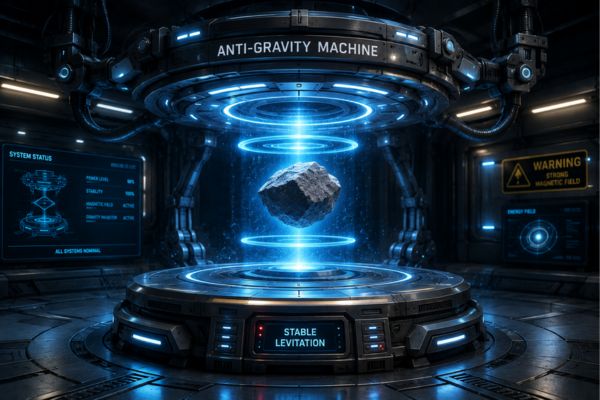
Gravity has governed every moment of human existence since the first creatures walked the Earth. It keeps us grounded, shapes our biology, and defines the very way we move through the world. So, naturally, the idea of a machine that could counteract or even eliminate that force captures the imagination like very few things can. The anti gravity machine once the stuff of science fiction paperbacks and Hollywood blockbusters has quietly evolved into a genuine field of scientific inquiry, engineering ambition, and even everyday medical application.
But what exactly is an anti gravity machine? Is it real? And if so, why haven’t we heard more about it? Let’s dig into the science, the history, and the surprisingly practical world of anti gravity technology.
What Is an Anti Gravity Machine?
At its most basic, an anti gravity machine is any device or system designed to counteract, simulate, or reduce the effects of gravitational force on an object or a person. The term itself is broad and that’s part of what makes it so fascinating. Depending on who you ask, an anti gravity machine could refer to an experimental propulsion system being tested in a university lab, a medical rehabilitation device helping patients walk again, or a theoretical spacecraft engine that exists only in equations and ambition.
Importantly, true anti gravity in the sense of completely nullifying the gravitational pull of a planet remains beyond our current technological capability. However, that hasn’t stopped scientists and engineers from developing systems that mimic or partially reproduce anti gravitational effects in remarkably useful ways.
The Science Behind the Concept
To understand how an anti gravity machine might work, you first need to appreciate what gravity actually is. According to Einstein’s general theory of relativity, gravity isn’t simply a force — it’s a curvature in spacetime caused by mass. The more massive an object, the more it warps the fabric of space around it, pulling other objects toward it.
For a machine to truly negate gravity, it would theoretically need to alter or counteract that curvature. Some researchers have proposed using electromagnetic fields, exotic matter, or quantum-level manipulation of particles to achieve this. Others have explored the concept of gravitational shielding essentially creating a barrier between an object and the gravitational influence of a larger mass. None of these approaches have produced a validated, reproducible result at scale, but the theoretical groundwork is genuinely compelling and continues to drive research forward.
Real-World Anti Gravity Machines That Actually Exist
Here’s where things get particularly interesting. While a true gravity-cancelling device remains elusive, several technologies already exist that effectively achieve anti gravitational results in practical, measurable ways.
Anti Gravity Treadmills in Medical Rehabilitation
One of the most widely used and clinically proven examples of anti gravity machine technology is the anti gravity treadmill. Used extensively in physiotherapy clinics, sports rehabilitation centres, and hospitals, these machines use air pressure differentials to reduce the effective body weight of the user whilst they walk or run.
The system works by sealing the lower body inside an inflatable chamber. As air pressure builds within the chamber, it lifts the user slightly, reducing the load on their joints, muscles, and bones. Patients recovering from surgery, strokes, or serious injuries can begin walking and exercising far sooner than would otherwise be safe. Athletes use these machines to train at high intensities with dramatically reduced injury risk. It’s a genuine medical breakthrough and it owes its existence entirely to the pursuit of anti gravity solutions.
Space Research and the Lower Body Negative Pressure Device
Beyond rehabilitation, space agencies have long grappled with the physical toll that weightlessness takes on the human body. Astronauts on long missions experience muscle atrophy, bone density loss, and cardiovascular changes all consequences of living without gravity’s constant resistance.
To counteract this, researchers developed the Lower Body Negative Pressure device, another form of anti gravity machine that creates a partial vacuum around the lower half of the body. This simulates the gravitational pull that the legs and torso would normally experience on Earth, helping astronauts maintain their physical health during extended missions. It’s a clever inversion of the anti gravity treadmill principle rather than lifting the body up, it pulls blood and fluid downward, mimicking the body’s natural response to standing upright under gravity.
Experimental Propulsion Research
On the more speculative though no less serious end of the spectrum, independent researchers and aerospace engineers continue to investigate propulsion systems that could one day function as a genuine anti gravity machine for spacecraft. One notable example is the EmDrive, a microwave-based thruster proposed by British engineer Roger Shawyer. The concept suggests that microwaves bouncing inside a specially shaped reflective cone could generate thrust without any propellant. Critics argue it violates the conservation of momentum, whilst some experimental tests have produced intriguing anomalies. The debate continues, and whilst the EmDrive has not been proven to work reliably, it represents the kind of boundary-pushing thinking that has always driven human progress.
Why the Anti Gravity Machine Matters More Than Ever
We live in an era where space exploration is no longer the exclusive domain of government agencies. Private companies are launching satellites, planning Mars missions, and developing next-generation spacecraft at a pace that would have seemed extraordinary just twenty years ago. In that context, the search for a viable anti gravity machine isn’t fringe science it’s a genuinely strategic priority.
Furthermore, ageing populations across the developed world are placing enormous pressure on healthcare systems. Technologies like anti gravity treadmills and related rehabilitation devices offer a meaningful way to reduce recovery times, improve patient outcomes, and ultimately lower costs. The anti gravity machine, in this sense, isn’t just a futuristic fantasy. It’s already improving lives in physiotherapy rooms across the UK, the US, and beyond.
The Boundary Between Fiction and Possibility
There’s a reason the anti gravity machine has endured as one of humanity’s most persistent technological dreams. It represents freedom from limitation, from the relentless pull of a force we’ve never been able to escape. Throughout history, scientists initially dismissed countless ideas that later became reality. Flight, wireless communication, and organ transplantation all seemed impossibly far-fetched before they weren’t.
The anti gravity machine may yet follow the same path. Researchers are exploring quantum mechanics, dark energy, and gravitational wave physics in ways that were simply not possible a generation ago. Each new discovery edges us closer to understanding gravity at a deeper level and understanding something is always the first step toward controlling it.
The Future of Anti Gravity Technology
Looking ahead, the most credible near-term advancements in anti gravity machine technology are likely to come from the medical and aerospace sectors. Improved versions of pressure-based rehabilitation devices will become more accessible and affordable. Meanwhile, continued investment in advanced propulsion research particularly from private aerospace ventures will keep the theoretical side of anti gravity science moving forward.
Longer term, breakthroughs in quantum physics or materials science could open entirely new avenues. Some physicists speculate that manipulating the Higgs field the mechanism by which particles acquire mass could one day offer a route to genuine gravity modification. It sounds extraordinary, and indeed it is. But then again, so did landing on the Moon.
Final Thoughts
The anti gravity machine sits at a fascinating crossroads between established science and bold imagination. On one hand, it already exists in practical, life-changing forms helping injured athletes recover, supporting astronauts in space, and advancing our understanding of human physiology. On the other hand, the ultimate version of the technology a device that truly defies gravity remains one of science’s greatest open questions.
What’s clear is that the pursuit of the anti gravity machine is not slowing down. If anything, it’s accelerating. And whether the next breakthrough comes from a rehabilitation clinic, a university laboratory, or a private aerospace company, one thing is certain: humanity has never been content to stay grounded for long.
