

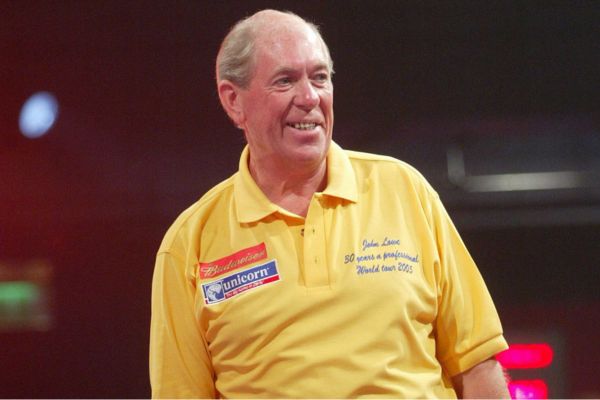
There are sporting legends, and then there are those rare individuals who do not simply dominate their era they reshape it entirely. John Lowe belongs firmly in the second category. Widely recognised as one of the greatest darts players Britain has ever produced, Lowe spent decades at the top of a fiercely competitive sport, accumulating titles, breaking records, and earning the kind of respect that outlasts any trophy. Yet despite his extraordinary achievements, he remains one of the most understated champions in British sporting history. That combination of brilliance and humility is precisely what makes his story so worth telling.
From Derbyshire Pub Culture to Professional Greatness
John Lowe was born on 21 July 1945 in New Tupton, a small village in Derbyshire, England. He grew up in a working-class environment where the local pub was the beating heart of the community, and darts was very much part of that social fabric. It was not a sport played under stadium floodlights back then it was a game of the people, played on worn boards in smoke-filled rooms, and Lowe took to it with quiet, focused intensity from a young age.
He turned professional in 1975, and within a year he had already announced himself on the big stage. In 1976, competing in the inaugural Winmau World Masters, Lowe claimed victory in impressive fashion, defeating Phil Obbard of Wales 3–0 in the final. It was a statement of intent. The darts world was put on notice, though few could have anticipated just how long and how dominantly John Lowe would remain at its summit.
Three World Titles Across Three Decades
If one achievement defines the remarkable career of John Lowe, it is this: he won the World Darts Championship in three completely separate decades in 1979, 1987, and 1993. Only Phil Taylor shares this distinction, and even that comparison requires some context. Lowe achieved it first. He is, therefore, not only a three-time world champion but a genuine pioneer of sporting longevity.
His 1979 title came during a period when darts was rapidly gaining mainstream attention in Britain. Television coverage was expanding, audiences were growing, and a new generation of fans was discovering the sport. Lowe rode that wave without ever letting it carry him away. He remained grounded, methodical, and devastatingly precise at the oche.
The 1987 and 1993 Championships
Winning once is an achievement. Winning twice proves it was no fluke. Winning a third time, fourteen years after the first that is something else altogether. By the time Lowe claimed his third world title in 1993, he was 47 years old, competing against a new generation of hungry, talented players who had grown up watching him play. Rather than fading into the background as an elder statesman, he defeated them. That victory stands as one of the most compelling statements of sustained excellence in darts history.
Beyond the three world titles, Lowe also collected two World Masters titles, two World Cup singles crowns, two British Open titles, and three European Cup singles titles. In total, he won 15 BDO and WDF majors and held the World No. 1 ranking on four occasions. These are not the numbers of a player who got lucky; they are the numbers of a complete, all-round champion.
The Nine-Dart Finish That Changed Everything
On 13 October 1984, John Lowe wrote himself permanently into darts folklore. Competing in the World Matchplay tournament against Keith Deller, he achieved the first ever televised nine-dart finish — the sport’s equivalent of a perfect game, a feat of such precision that the odds against it are almost incomprehensible. He completed the finish via a third visit combination of treble 17, treble 18, and double 18. It was breathtaking, and it was brilliant.
The financial reward reflected the magnitude of the moment. Lowe received £102,000 for the nine-dart finish alone a sum that remained the highest amount earned by any darts player at a single tournament for almost two decades. He also went on to win the tournament itself, adding a further £12,000 to the total. The nine-dart finish was not shown live; instead, it aired on a highlights programme on ITV. Nevertheless, its impact was seismic. It elevated darts to a level of precision and drama that attracted a whole new audience to the sport.
Why That Moment Still Matters
More than forty years later, the nine-dart finish remains the holy grail of darts. Achieving it in front of a camera under tournament pressure, with everything on the line — is extraordinarily difficult. John Lowe did not stumble into this moment. He executed it with the cool, controlled precision that earned him his famous nickname: “Old Stoneface.” That composure, that ability to shut out distraction and deliver under pressure, defined his entire career.
The Man Behind the Nickname
“Old Stoneface” is a nickname that tells you everything about John Lowe’s on-stage presence. Where other players wore their emotions openly pacing, gesturing, shouting Lowe simply stood at the oche and threw. His expression rarely changed. His routine rarely varied. His focus was absolute. Opponents found it deeply unsettling, and understandably so. There is something uniquely intimidating about a player who never seems rattled, never seems uncertain, never gives you a single crack in the armour.
Off the board, however, Lowe was always known as a warm, approachable, and thoroughly decent man. Another nickname, “the Gentleman of the Game,” reflects this equally important side of his character. He represented England over 100 times at international level and captained the national team for seven consecutive years without a single defeat a record that speaks not only to his individual skill but to his leadership and collective spirit.
A Pioneer in the PDC Revolution
In 1993, John Lowe was one of 16 leading players who broke away from the British Darts Organisation amid growing frustrations with the governing body’s direction. Together, they formed the World Darts Council, which subsequently became the Professional Darts Corporation the PDC that dominates the sport today. This was not a small decision; it was a fundamental restructuring of professional darts, and Lowe was right at the centre of it.
His willingness to take that bold step demonstrated something important: beneath the stoic exterior was a man who cared deeply about the future of his sport. He did not simply play darts for prize money; he invested in its integrity, its structure, and its long-term growth. The PDC, which now commands massive television audiences and enormous prize funds, owes a significant debt to those founding members — and John Lowe deserves his share of that credit.
Legacy, Later Life, and Lasting Influence
After retiring from the peak of competition, John Lowe remained closely connected to the sport he helped build. In May 2009, he published The Art of Darts, a book in which he shared his personal insights and techniques for both amateur enthusiasts and aspiring professionals. By 2013, the book had been adapted into a mobile app for iPhone and iPad, introducing his wisdom to an entirely new generation of players.
He continued to compete well into his seventies, appearing in the inaugural 2022 World Seniors Darts Championship, reaching the last 16. That he was still competing at that level, at that age, is a testament to his enduring love for the game. In 2018, the British government awarded him an MBE a recognition long overdue for a man who had given so much to British sport.
He has made 28 consecutive appearances at the World Darts Championship between 1978 and 2005, a record for consistency in the event’s early history. He is married to Karen and lives in Chesterfield, and the couple are devoted supporters of Sunderland Football Club.
Why John Lowe Deserves Greater Recognition
It is a curious quirk of British sporting culture that darts does not always receive the same reverence as cricket, football, or tennis. Yet the achievements of John Lowe three world titles, a historic nine-dart finish, 28 consecutive World Championship appearances, unbeaten national captaincy, a founding role in the PDC would be celebrated with enormous fanfare in almost any other sport.
He played at the very highest level for over three decades, maintained impeccable standards of sportsmanship throughout, and helped transform darts from a pub pastime into a professionally organised, globally televised sport. He did all of this quietly, with his characteristic composure, and without ever demanding the recognition he deserved.
John Lowe is, without any doubt, one of the finest sportsmen Britain has produced. Old Stoneface never cracked and neither has his legacy.
