

Walk into any physiotherapy clinic or well-run gym session, and sooner or later you’ll spot someone on all fours, slowly reaching one arm forward while extending the opposite leg behind them. That’s the bird dog exercise, and despite looking almost too simple to matter, it’s one of the most respected core moves in the entire fitness world. Trainers love it, physios prescribe it, and for good reason, it genuinely delivers.
Unlike flashy core workouts built around speed and burn, the bird dog exercise takes the opposite approach entirely. It’s slow, deliberate, and almost meditative in execution, yet it works your entire posterior chain alongside your abdominals. Whether you’re recovering from a back injury, sitting at a desk all day, or simply chasing better balance, this exercise earns its place in your routine far more than its understated reputation might suggest.
What Is the Bird Dog Exercise, Really?
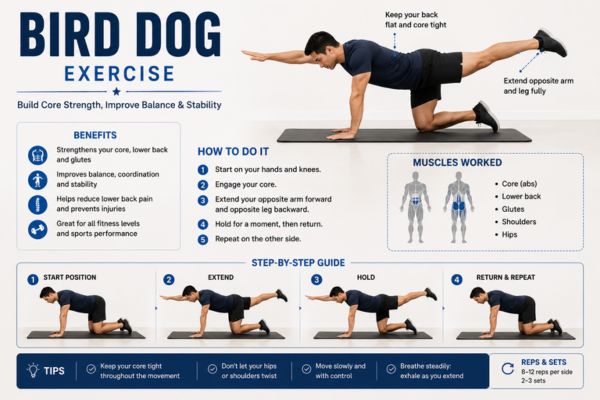
At its simplest, the bird dog exercise is performed on your hands and knees in what’s called a quadruped position. From there, you extend one arm forward and the opposite leg backward simultaneously, holding everything steady while your spine stays neutral throughout. Once you release that position, you switch sides and repeat the movement, building strength and stability on both sides of your body evenly.
What sets this exercise apart from typical ab work is its anti-rotation demand. Because you’re extending opposite limbs at once, your core has to actively resist any twisting or sagging through your torso. This is precisely the kind of control your spine relies on during real-life movement, whether you’re reaching for something on a high shelf or twisting to grab a seatbelt. Training that resistance pays off well beyond the gym floor.
Why the Bird Dog Deserves a Spot in Your Routine
It’s tempting to dismiss the bird dog exercise as too gentle to matter, especially if you’re used to chasing muscle burn and visible fatigue. However, that mindset misses the entire point of what this movement is designed to achieve. Rather than building raw strength, the bird dog trains your nervous system to coordinate muscles across your entire body, which is arguably just as valuable for long-term function and injury prevention.
Research backs this up convincingly. Studies comparing classic rehabilitation exercises found the bird dog caused noticeably less muscular fatigue than other common moves, yet still strengthened the abdominal and back muscles effectively. That combination makes it particularly useful for people dealing with lower back pain, since it builds strength without aggravating already sensitive areas of the spine.
A Genuine Ally for Lower Back Pain
If you’ve ever struggled with nagging back discomfort, you’ll know how frustrating it is when most exercises seem to make things worse rather than better. The bird dog exercise tends to be the exception. Because it keeps the spine supported in a neutral position throughout, it allows people with existing back issues to strengthen their core without placing excessive strain on vulnerable areas, which honestly isn’t something every core exercise can claim.
Beyond pain relief, the move also strengthens the gluteus maximus, providing extra support for the lower back during everyday activities. Sitting for long stretches weakens the connection between your upper and lower body, particularly around the hips, and this imbalance often contributes to back problems down the line. The bird dog directly addresses that weakness, helping restore proper movement patterns over time.
How to Perform the Bird Dog Exercise With Proper Form
Good technique separates an effective bird dog from a wasted repetition, so it’s worth slowing down and getting the basics right before adding any complexity. Start in a tabletop position with your hands placed directly under your shoulders and your knees positioned under your hips. Engage your core by gently drawing your belly button towards your spine, ensuring your back stays flat rather than sagging or arching.
From this braced position, slowly extend your right arm forward while simultaneously straightening your left leg backward, raising it until it’s roughly parallel with the floor. Keep your hips level throughout, resisting any urge to rotate or tilt your pelvis as you extend. Hold this position for a few seconds, focusing on stability rather than height, then return with control before switching to the opposite side.
Common Mistakes That Undermine the Movement
The most frequent error involves letting the hips drop or rotate as the leg lifts, which usually happens when people prioritise height over control. Rather than chasing a dramatic leg extension, focus on keeping your midsection completely stable, even if that means lifting your limbs only slightly above the floor initially. Quality control matters infinitely more than range of motion with this particular exercise.
Another common slip-up is rushing through repetitions without pausing at the top. Moving too quickly reduces muscle activation significantly, robbing you of much of the exercise’s benefit. Similarly, many people crane their neck upward instead of keeping their gaze directed towards the floor, which places unnecessary strain on the neck and often causes the back to sag in response. Slow, controlled breathing throughout each rep helps maintain that necessary tension.
Modifications and Progressions Worth Trying
Beginners often find the full bird dog exercise surprisingly demanding, particularly when it comes to maintaining balance while moving opposite limbs together. If that’s the case for you, it’s perfectly reasonable to break the movement into separate steps. Extend just one arm forward first, hold briefly, then return before extending the opposite leg on its own. This builds the necessary stability gradually, without overwhelming your coordination too soon.
Once the basic version feels manageable, there’s plenty of room to progress further. Adding light ankle weights or holding a small dumbbell in your extended hand increases the challenge considerably, as does extending your hold time at the top of each repetition. For an extra balance test, try performing the exercise on an unstable surface, or progress towards a bear-crawl variation where your knees hover just above the ground throughout.
How Often Should You Train the Bird Dog?
Because the bird dog exercise is low-impact and places minimal strain on the joints, it fits comfortably into almost any weekly training schedule. Most trainers suggest performing around three sets of ten to fifteen repetitions per side, ideally several times a week, whether as part of a dedicated core session or tucked into your warm-up routine before heavier lifting.
Pairing the bird dog with complementary moves, such as the dead bug or glute bridges, rounds out your core training nicely. Since the bird dog focuses primarily on resisting rotation, combining it with exercises targeting different stability demands ensures your entire midsection develops evenly. Over weeks and months, this balanced approach tends to produce noticeably better posture, coordination, and resilience against everyday strain.
Final Thoughts
The bird dog exercise won’t leave you breathless, and it certainly won’t make for an impressive workout video clip. Still, its real power lies in something far more valuable than a quick burn: genuine, functional stability that protects your spine through ordinary daily movement. Whether you’re managing back pain, rebuilding strength after time away from training, or simply wanting a more resilient core, this quietly effective exercise deserves consistent attention rather than a passing glance.
