

If you’ve ever wandered through a gym and spotted someone lying on their back, waving their arms and legs about like an upturned beetle, you’ve probably stumbled across the dead bug exercise. It looks faintly ridiculous, admittedly. But don’t let appearances fool you, because this move is one of the most underrated core exercises around, and physiotherapists, trainers, and rehab specialists swear by it for good reason.
Unlike crunches or sit-ups, which mostly hammer away at your superficial abdominal muscles, the dead bug exercise digs deeper. It targets the transversus abdominis, that deep corset-like muscle wrapping around your midsection, while also training coordination between opposite limbs. The result is a stronger, more stable core that actually supports your spine during everyday movement, rather than just looking good in a mirror.
What Exactly Is the Dead Bug Exercise?
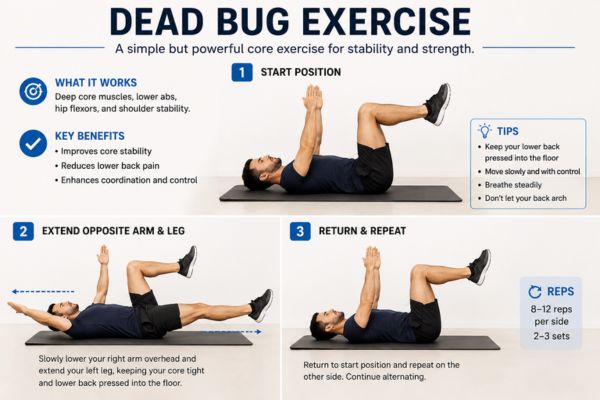
At its core (pun fully intended), the dead bug exercise is a supine movement, meaning you perform it lying flat on your back. You start with your knees and hips bent at right angles, arms reaching towards the ceiling, and then you slowly extend one arm and the opposite leg while keeping your lower back pinned firmly to the floor. Once you’ve mastered that, you switch sides and repeat.
What makes this exercise so clever is the cross-body pattern involved. Because you’re moving your left arm and right leg simultaneously, rather than both limbs on the same side, your brain has to work a little harder to keep everything coordinated. This is often referred to as a “cross-crawl” pattern, and it mirrors the way we naturally move when walking or running. Consequently, the dead bug doesn’t just build strength; it also sharpens motor control and body awareness.
Why Your Core Actually Needs This Move
Most people assume a strong core means visible abs, but that’s only part of the picture. True core strength is about stability and control, particularly the ability to resist unwanted movement in your spine. The dead bug exercise excels here because it trains what’s known as anti-extension strength, which is essentially your core’s capacity to stop your lower back from arching under load.
This matters more than you might think. Every time you lift something heavy, twist to reach for an object, or even cough suddenly, your core has to brace and protect your spine. If that bracing mechanism is weak or poorly coordinated, you’re far more likely to end up with nagging lower back pain. Practising the dead bug regularly helps you build that protective reflex, so your spine stays supported during real-world movements, not just in the gym.
A Safer Alternative to Traditional Ab Exercises
Many traditional core exercises, sit-ups in particular, place considerable strain on the lumbar spine. For people with existing back issues, or those simply wanting to train smarter, this can be a problem. The dead bug, on the other hand, keeps your spine in a neutral, supported position throughout, which makes it one of the safer options available, even for older adults or post-rehab patients.
That said, safety doesn’t mean it’s easy. Because the exercise demands constant core engagement and controlled breathing, it can feel surprisingly challenging once you slow down and focus on quality over speed. Many people rush through it without bracing properly, which honestly defeats the entire purpose of doing it in the first place.
How to Perform the Dead Bug Exercise Correctly
Getting the technique right is essential, otherwise you risk turning a brilliant exercise into a wasted effort. Begin by lying flat on your back on a mat, with your knees bent at ninety degrees directly above your hips. Extend your arms straight up towards the ceiling, positioned right above your shoulders, almost as though you’re holding an invisible box overhead.
From there, engage your core by gently drawing your belly button towards your spine, much like you’re bracing for a light punch to the stomach. While maintaining that tension, slowly lower your right arm backwards towards the floor behind your head, while simultaneously extending your left leg outward until it hovers just above the ground. Pause briefly, then return to the starting position before switching sides. Throughout the entire movement, your lower back should remain pressed into the floor, never arching upward.
Common Mistakes to Watch Out For
One of the biggest errors people make is letting their lower back lift off the floor as their limbs extend. This usually happens when the core isn’t braced properly, or when the movement is performed too quickly. If you notice this happening, it’s worth scaling back the range of motion until your control improves, rather than pushing through with poor form.
Another frequent mistake involves holding the breath. It’s a natural instinct when concentrating hard, but it actually increases tension in all the wrong places and reduces the effectiveness of the exercise. Instead, aim for slow, steady breathing throughout each repetition, exhaling gently as you extend your limbs and inhaling as you return to the start.
Modifications for Every Fitness Level
The beauty of the dead bug exercise lies in how adaptable it is, regardless of where you’re starting from. Beginners, or anyone with limited core strength, can simplify the movement by keeping their feet flat on the floor and only moving one arm at a time. This reduces the load on the lower back while still teaching proper bracing technique, which is genuinely the most important part to master early on.
For those who find the standard version too easy, there’s plenty of room to progress. Straightening the legs fully, adding a small crunch as the limbs extend, or incorporating a light resistance band can all increase the challenge considerably. Pregnant women in later trimesters might prefer an inclined version using a bolster behind the back, since lying completely flat can sometimes cause discomfort or dizziness.
How Often Should You Do Dead Bugs?
Consistency tends to matter more than intensity with this particular exercise. Most experts recommend performing the dead bug exercise around three to four times a week, doing one to three sets of eight to twelve repetitions per side. Because it’s low-impact and gentle on the joints, it fits comfortably into almost any training schedule, whether you’re warming up before a workout or cooling down afterwards.
It’s also worth pairing the dead bug with other core stability exercises, such as planks or bird dogs, for a more rounded routine. Doing so ensures you’re training your core from multiple angles, rather than relying on a single movement pattern to do all the work. Over time, this combination builds a noticeably more resilient midsection.
Final Thoughts
The dead bug exercise might not look impressive, and it certainly won’t leave you gasping for breath the way a sprint session would. Yet its real value lies in what it builds quietly beneath the surface: a stable, well-coordinated core that protects your spine through everyday life. Whether you’re recovering from injury, easing into fitness for the first time, or simply looking to strengthen your foundation, this unassuming little exercise deserves a permanent spot in your routine.
